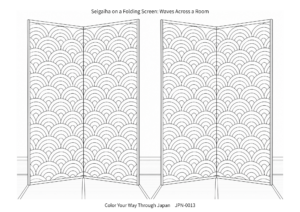
※ You can download the coloring page PDF for free.
Rows of rounded waves spread across a folding screen, one band rising behind another. There is no shoreline, horizon or breaking surf. The sense of water comes from repetition: curved shapes return at regular intervals, creating a surface that seems capable of continuing beyond the frame. This is seigaiha, a Japanese wave pattern whose ordered geometry has traveled across many kinds of decorative objects.
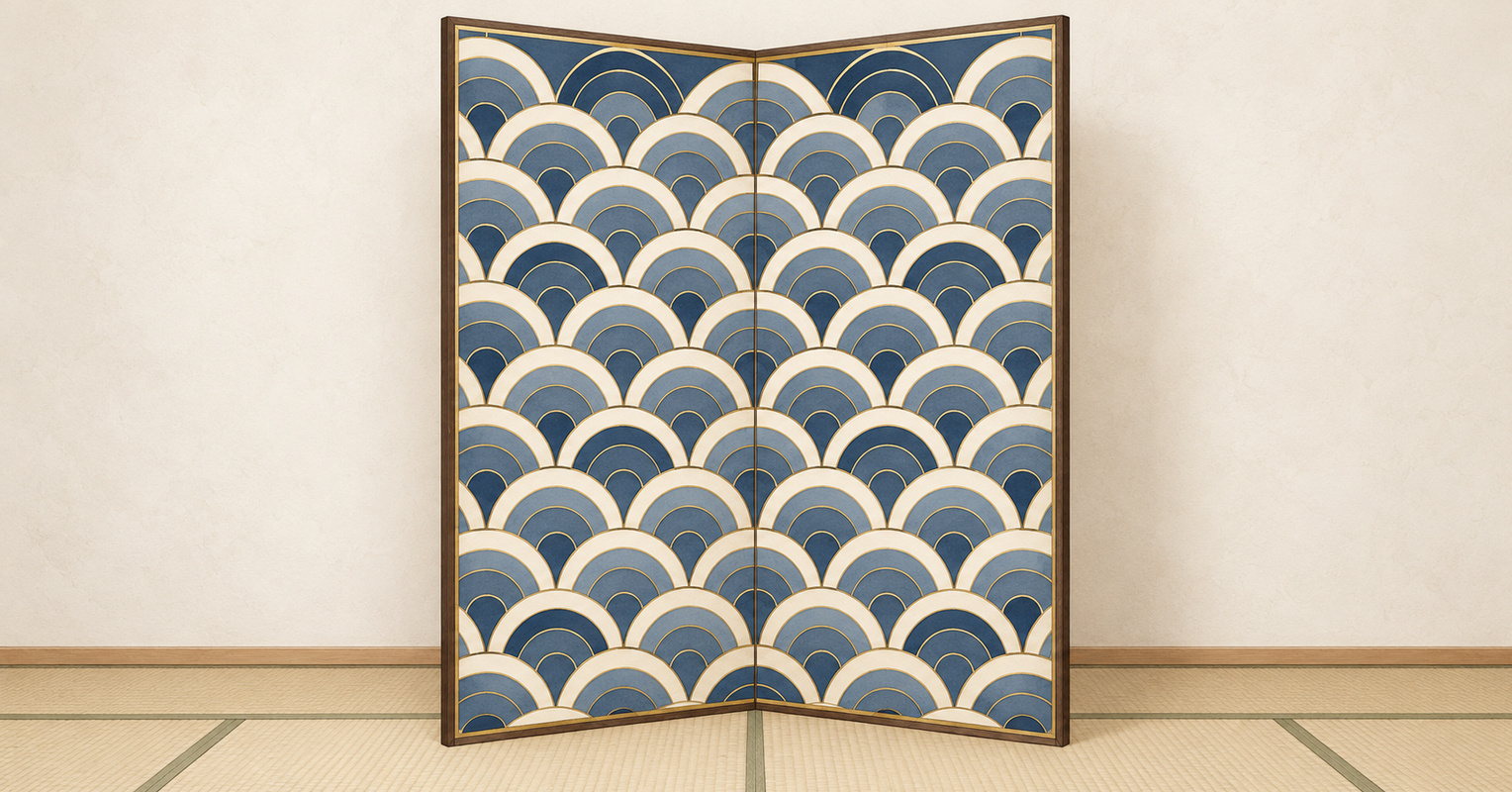
The name is commonly translated as “blue ocean waves,” but the motif is recognizable through its shape rather than any single color. On the original screen design shown here, nested arcs cover two upright panels joined by a central fold. The setting is deliberately simple, allowing the relationship between pattern and object to remain clear. It is a contemporary imagined design using a traditional motif, rather than a reproduction of a particular antique screen.
A Sea Made from Repeated Arcs
Seigaiha is built from groups of concentric curves. Each group resembles the upper portion of several circles sharing a center. Arranged in overlapping, staggered rows, these units create an orderly field of waves. The overlap is essential to the effect: a row partly conceals the shapes behind it, so the pattern suggests successive ranks of water rather than a collection of separate rings.
The motif has appeared in textiles, ceramics and lacquerware, as well as in architectural decoration. It is also associated with costumes used in gagaku, Japan's tradition of court music and dance. Its history crosses different materials and periods, making it more useful to understand as a recurring decorative vocabulary than as a design belonging to one type of object.
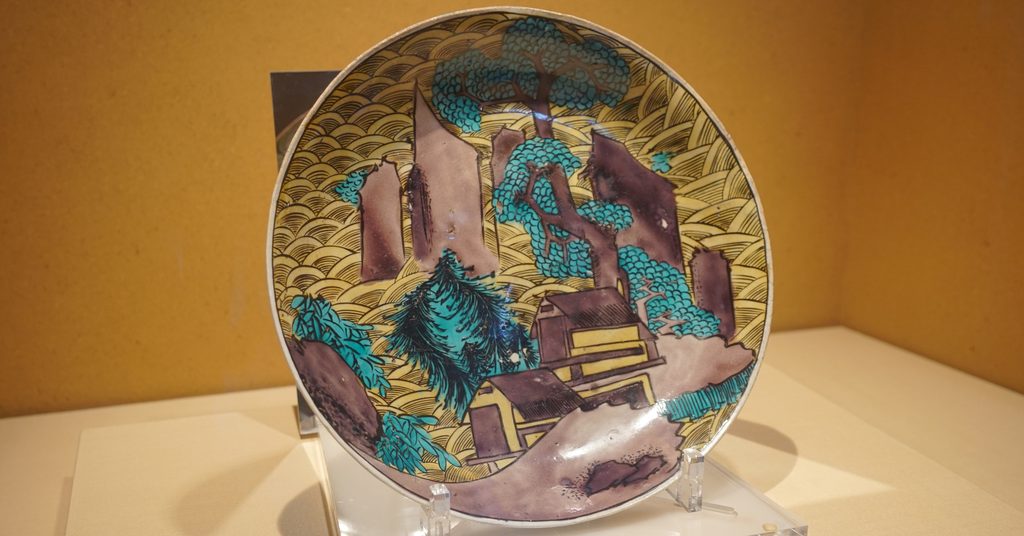
The ceramic example accompanying this section places wave bands among landscape details. Trees, buildings and rocky forms interrupt the repeated curves, yet the wave structure remains legible around them. That combination shows how a regular motif can share a surface with a less regular image. A pattern does not have to cover an object completely to give it a strong visual rhythm.
Lacquer offers another expression of the same idea. The Museum of the Imperial Collections holds an inkstone box with seigaiha decoration attributed to Seigai Kanshichi. Its catalog describes a technique for expressing rippling waves, with small gold and silver elements suggesting spray. This is a particular lacquer treatment, distinct from simply drawing the familiar semicircular repeat on paper.
The pattern also carries auspicious associations. Its continuing waves can express a wish for lasting happiness. Such meanings remain open to an object's context and maker: contemporary craftspeople have used seigaiha in works concerned with recovery and hopes for the future. The repeated shapes provide continuity, while their application allows new meanings to develop.
A Folding Surface for Art
A Japanese folding screen is called a byobu. The word refers to screening the wind, but the object has long served both practical and artistic purposes. Screens can divide or shelter part of a room, provide a decorative backdrop and display painting or calligraphy. Their ability to fold also makes them portable furnishings that can be stored when no longer needed.
Traditional Japanese screens are not simply solid boards covered with pictures. A light wooden framework contains a lattice of thin strips. Layers of paper cover this structure and support the finished surface, while paper hinges join the panels. An outer wooden frame completes the object. Much of this construction remains hidden behind the image, although its lightness and flexibility shape how the screen functions.
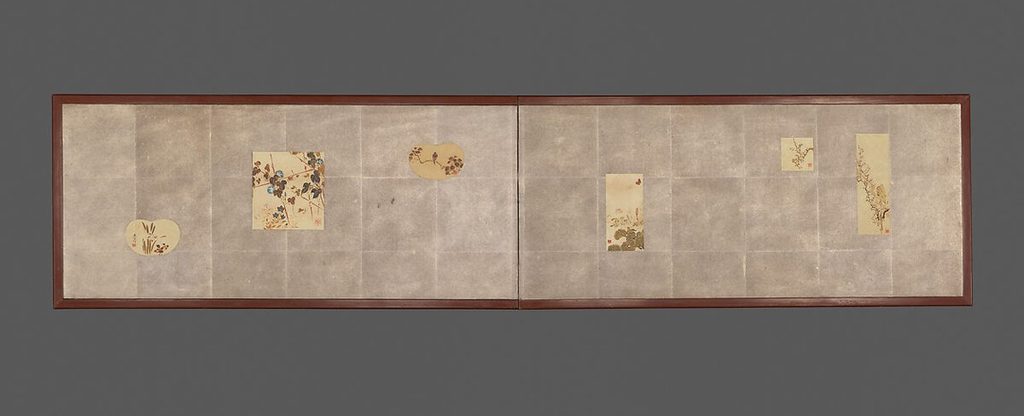
Paper hinges also helped artists treat adjoining panels as one broad pictorial field. Without heavy separate frames around every panel, a composition could continue across the folds. Screens may have two, six or other numbers of panels; the historical tea screen pictured here uses two, with small bird-and-flower paintings arranged over a quiet ground.
In the imagined seigaiha screen, the same two-panel format carries a continuous wave field. The central fold changes the angle of the surface, while the motif keeps its repeated rhythm. Straight outer edges contain the curves, and the slight bend gives a flat decorative pattern a presence within the room.
Seigaiha and the folding screen meet through this balance of continuity and division. Individual arcs form a larger pattern, and separate panels support a single visual surface. The object remains simple in outline, yet its repeated waves make it feel expansive within the space it occupies.