※ You can download the coloring page PDF for free.
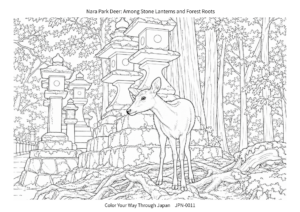
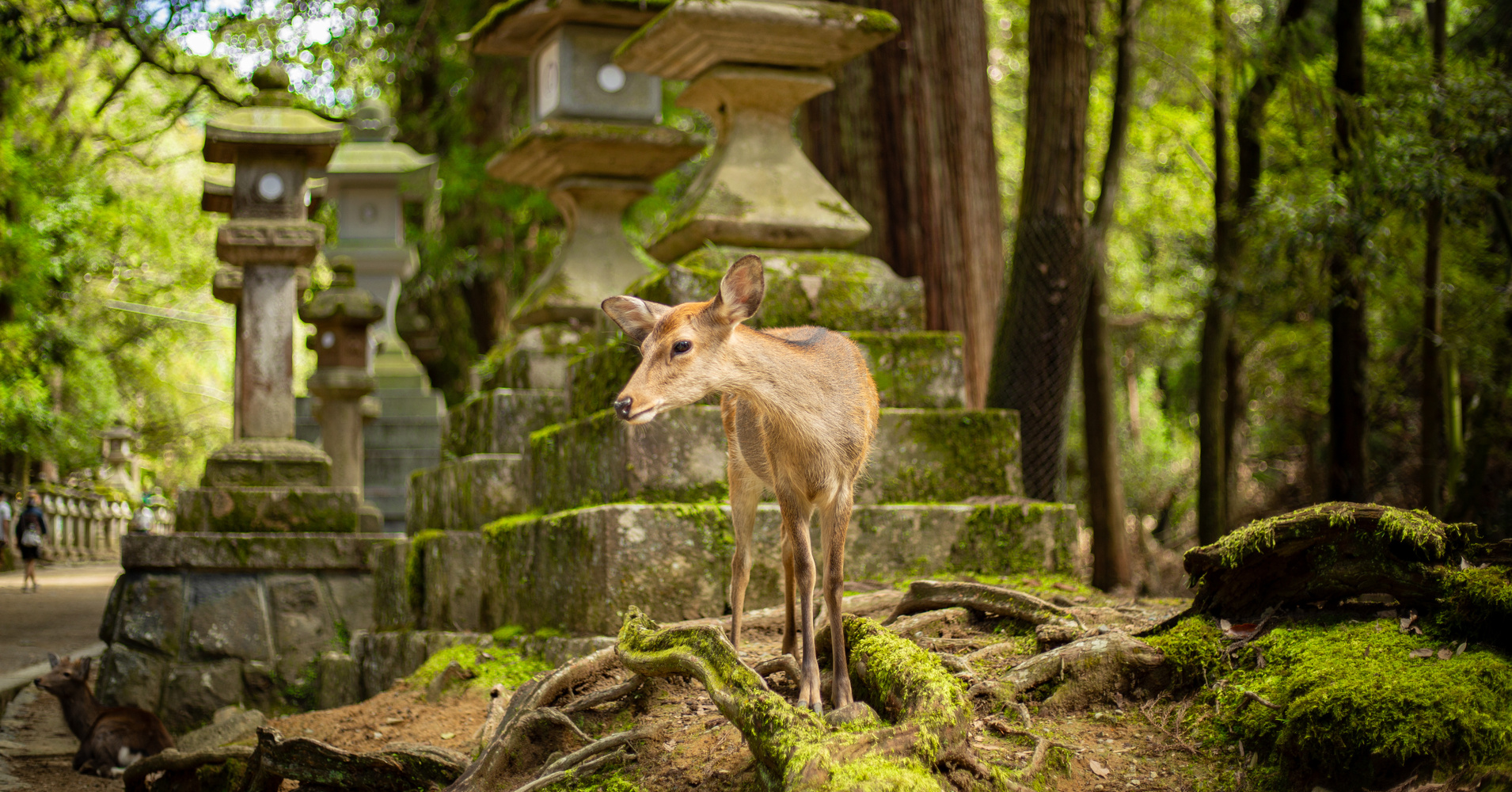
A deer stands between the exposed roots of a tree, its head turned toward a path. Behind it, stone lanterns recede into woodland, their broad caps and square chambers repeating between the trunks. This is one face of Nara Park: a place where an animal can become the center of a scene otherwise shaped by trees, stone and the passage of people.
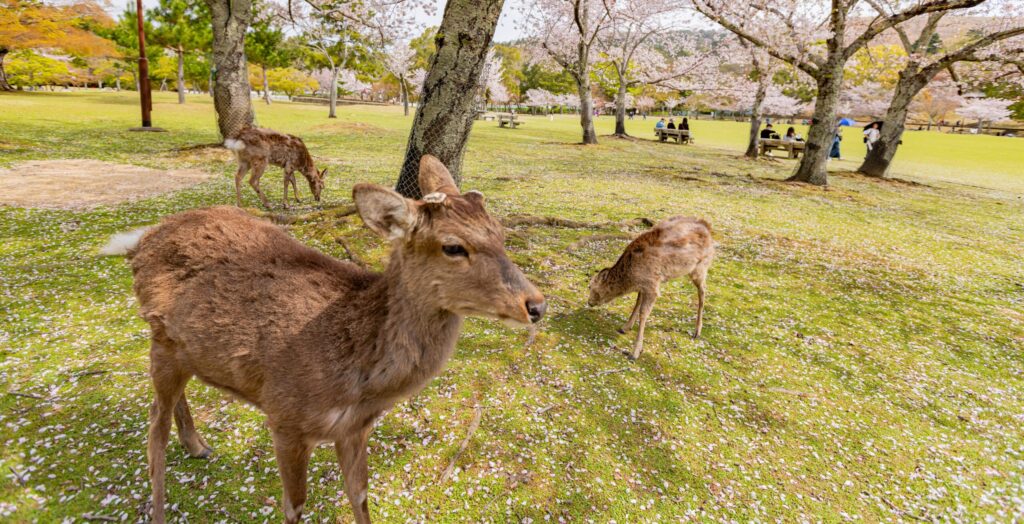
Nara Park lies in Nara City, in the Kansai region of Japan. Its wider landscape brings together open parkland, wooded ground and major cultural sites, including Todaiji Temple, Kofukuji Temple and Kasugataisha Shrine. Mount Wakakusa rises at the park's eastern side. The deer move through this varied setting, so their surroundings may be a lawn, a busy walkway or the quieter woodland near a shrine.
A Woodland Scene with a Sacred History
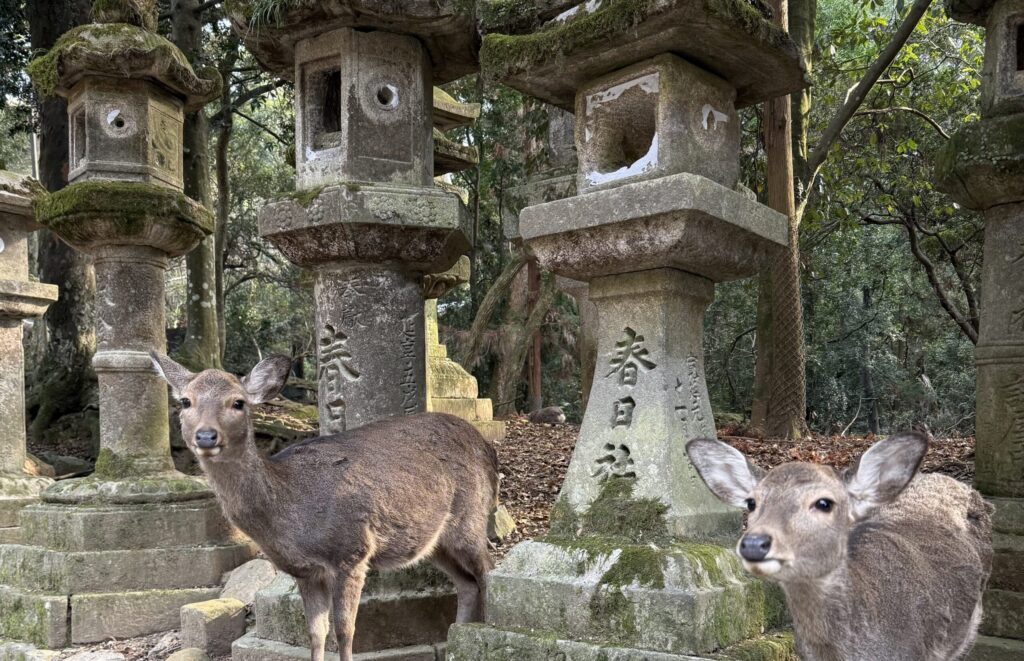
The view in the drawing comes from the wooded surroundings of Kasugataisha Shrine. A standing deer occupies the foreground, while a line of stone lanterns creates a route into the distance. Large roots cross the ground beneath its feet. The lanterns have the regular shapes of built objects, but moss, tree trunks and uneven earth soften their arrangement. The scene's character depends on that close meeting of living woodland and human craftsmanship.
Nara's association with deer reaches far beyond their presence in travel photographs. According to shrine tradition, a deity traveled from Kashima, in present-day Ibaraki Prefecture, to Nara on a white deer. This is a sacred origin story, rather than an account of how a wild population first arrived. Through the association with Kasugataisha, deer came to be revered as messengers of the gods.
That history gives an ordinary woodland encounter another layer of meaning. A deer beside a stone lantern belongs to the immediate scene, yet it also recalls a relationship sustained across many generations. Today, the deer of Nara are protected as a Natural Monument. Their cultural importance and their lives as animals exist together in the same landscape.
The illustration emphasizes this smaller, sheltered view rather than a panorama of the park. The deer's narrow muzzle and alert ears draw attention first; the repeated lanterns then carry the eye toward the path. Broad tree trunks rise behind both. These overlapping forms make the depth of the woodland visible without bringing every famous Nara landmark into a single picture.
Wild Deer in a Shared Landscape
Nara's deer are Japanese sika deer, whose scientific name is Cervus nippon. Their slender legs end in cloven hooves, with two principal toes bearing their weight. A summer coat typically has conspicuous pale spots, while the winter coat loses that spotted appearance. Seasonal changes help explain why photographs of Nara deer do not always show the same familiar pattern.
Only males grow antlers. These are shed and renewed in an annual cycle, so antlers alone cannot provide a simple, year-round picture of every deer. The animal in this woodland drawing has no antlers, matching the reference scene. Its body remains clearly separate from the roots beneath it, while the long legs show how delicately a deer stands within such uneven surroundings.
The park also provides food. Grass is central to the deer's diet, supplemented by other vegetation, including leaves and acorns. The shika senbei, or deer crackers, associated with visits to Nara are a supplementary snack rather than the animals' staple food. Beyond the familiar feeding encounters, much of their daily life involves grazing, resting and chewing cud.
Familiarity with people does not make these deer domestic animals. Their shared environment requires continuing care. The Nara Deer Preservation Foundation treats sick and injured deer and works to reduce problems such as traffic accidents and discarded rubbish. Rokuen, its protection facility near Kasugataisha, opened in 1892, giving this practical side of coexistence a long history of its own.
In the woodland scene, the deer, roots and lanterns occupy one continuous space. The animal is neither an ornament added to a historic setting nor separate from it. Its presence makes Nara's landscape distinctive: a place where religious memory, daily human movement and the life of a wild species remain closely connected.