※ You can download the coloring page PDF for free.
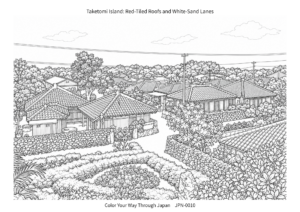
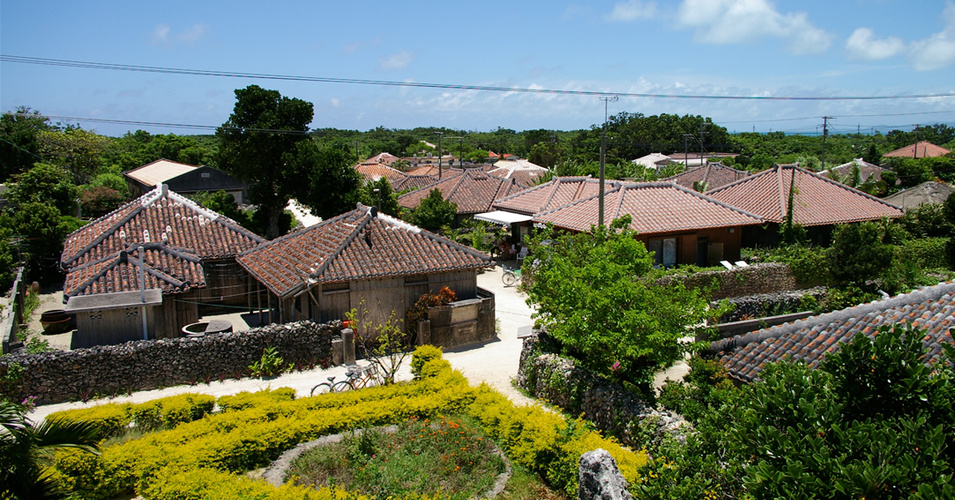
From above the village, Taketomi's roofs form a low, uneven patchwork among the trees. Curved tiles run down the slopes in repeated rows, while pale lanes open between stone walls below. The settlement has no single building that explains its character. Its distinctive scenery comes from the relationship between houses, gardens, boundaries and the narrow routes that connect them.
Taketomi Island lies in the Yaeyama Islands of Okinawa Prefecture, close to Ishigaki Island. It belongs to Taketomi Town, a municipality that includes several islands, and forms part of Iriomote-Ishigaki National Park. The village occupies the island's interior, with vegetation, agricultural land and the coast surrounding it. This is a lived-in community within an island landscape, with homes and local traditions continuing behind the familiar red roofs.
The Details That Shape the Village

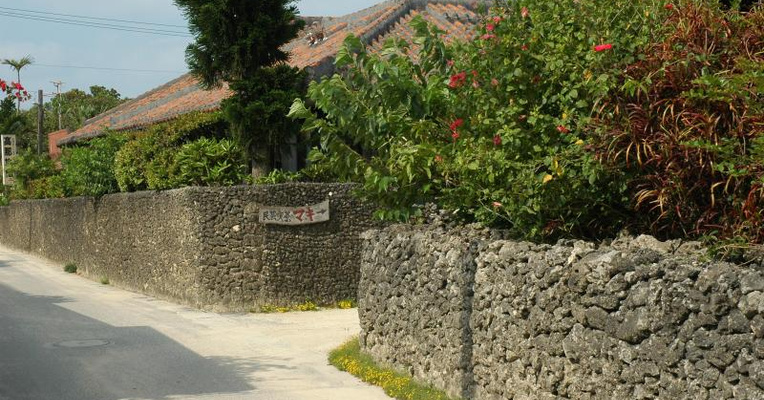
Three materials give the streets their immediately recognizable appearance: roof tiles, limestone and white sand. The reddish roofs sit above wooden houses, stone walls define individual plots, and the pale roads remain visually open between them. Trees and hedges soften these boundaries without erasing their shape. Hibiscus and bougainvillea are among the flowering plants associated with the village streets.
The roofs are especially distinctive when seen from an elevated viewpoint. Their ridges and sloping faces overlap, so one house partly hides the next. Rows of curved tiles turn each broad surface into a repeated pattern. Pale mortar between the tiles adds another rhythm, separating the warm clay surfaces and emphasizing the roof's construction. Weathering means that the tiles do not all have the same bright red appearance.
Some roofs carry a shisa, the lion-like guardian figure familiar across Okinawa. Its compact body and expressive face contrast with the regular tile courses around it. A roof can therefore have two different scales of detail: the large geometry of its slopes and a small figure standing among the tiles. These guardians belong to the island's domestic scenery rather than being confined to monumental buildings.
At ground level, the stone walls take over as the strongest continuous lines. Their irregular pieces create a rough texture beside the smoother-looking sand. Openings interrupt the walls where paths lead into individual properties. In the village view, the junction between these boundaries provides a clear route through the scene, while the gardens and houses remain separate spaces on either side.
The same arrangement changes with the viewpoint. From a lane, foliage can conceal much of a house, leaving only a roof visible above the wall. From higher ground, the roofs become prominent and the lanes appear as narrow gaps. Both views describe the same close relationship between buildings and planted enclosures.
A Landscape Sustained by Its Community
The red-tiled village is the result of change as well as continuity. Earlier houses had thatched roofs, and red tiles became increasingly prominent over time. Research on Taketomi's conservation movement describes how the number of red roofs grew as residents worked to protect the settlement. The familiar view reflects decisions about what to retain, repair and carry forward.
That commitment is expressed in the Taketomi Island Charter, adopted in 1986 and revised in 2017. Its principles address land, pollution, the appearance of the settlement, protection of the environment and the continuing role of local traditions. Preservation extends beyond the visible houses to beaches, woodland, sacred sites and community life. The village's designation as a traditional building preservation district forms another part of this wider context.
The walls also mark the boundary between public scenery and private life. The enclosed plots contain residents' homes and gardens, while the lanes connect the settlement. Maintaining the landscape therefore involves ordinary domestic spaces as well as places that attract visitors. The village's appearance cannot be separated from the people who continue to inhabit it.
Taketomi's character emerges where these elements meet: a tiled eave above foliage, a rough wall beside white sand, or a lane opening between neighboring homes. The red roofs are its most familiar image, but the spaces around them give the village its structure and everyday meaning.