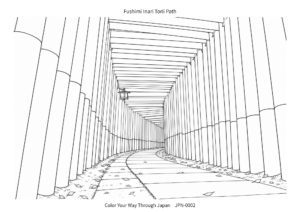
※ You can download the coloring page PDF for free.
At Fushimi Inari Taisha in southern Kyoto, a path runs through rows of closely spaced shrine gates. From inside, the view becomes a sequence of upright pillars and overhead beams, with each opening framing another farther ahead. A bend in the paving interrupts the long perspective, while narrow gaps between the gates admit glimpses of daylight. The effect comes from many separate structures standing close together, rather than from a single enclosed building.
These gates are torii, familiar markers of sacred space at Shinto shrines. Fushimi Inari's celebrated Senbon Torii, or “Thousand Torii,” form part of a much larger religious landscape on Mount Inari. Their striking appearance is inseparable from the people who have offered them, the prayers associated with them and the mountain paths they line.
Through the Repeating Frames
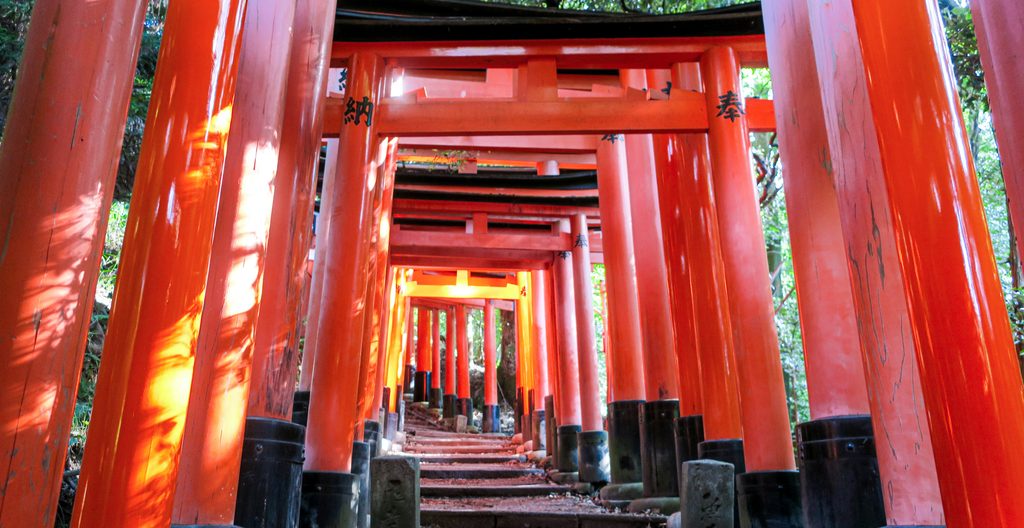
Inside the torii passage, two rows of rounded posts flank the stone walkway. Crosspieces span the space above, and the dark lower portions of the pillars establish a continuous band along the ground. In the distance, individual gates appear narrower and closer together. This repetition gives the path its strong sense of depth, even where only a short stretch is visible before a turn.
The gateways remain distinct structures. Small intervals between them allow light to enter from outside, creating patterns that change across the posts and paving. The corridor can therefore feel sheltered without being a room: its sides and overhead structure are formed by repeated openings. In the photographed view, a small hanging lantern adds another scale to the scene, set among wooden members much larger than itself.
The best-known dense passage is only one part of the shrine precinct. The Senbon Torii lead to Okusha Hohaisho, also called Okuno-in, east of the main shrine building. This prayer place faces the sacred mountain. Beyond the lower shrine area, other routes continue through wooded slopes and past smaller places of worship. The close framing of a torii corridor belongs to a wider landscape of trees, paths and sacred sites.
The mountain itself rises to 233 meters and forms part of the shrine grounds. Across it are small shrines and worship stones known as otsuka, bearing names under which devotees worship Inari. This gives the route a different character from an ornamental garden passage. Its built forms guide movement through a mountain that has religious significance in its own right.
Gates Offered in Prayer and Gratitude
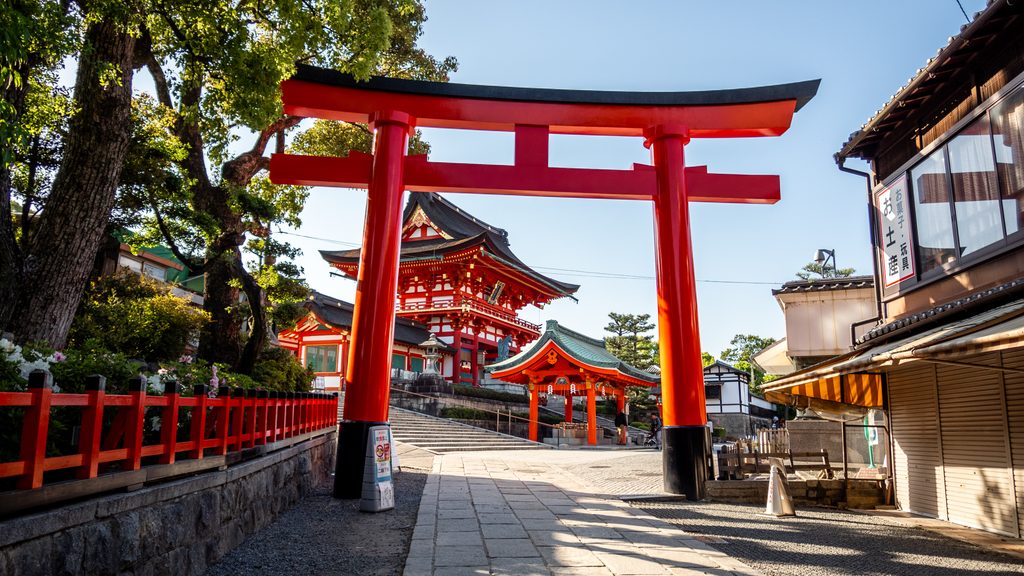
Fushimi Inari Taisha traces its establishment to 711 and is the head shrine of Japan's Inari shrines. Inari worship has longstanding connections with grain harvests, while prayers at the shrine also concern business prosperity, households and other aspects of daily life. The setting brings agricultural associations and the hopes of later generations into the same place.
The custom of offering torii became established in the Edo period. Gates were dedicated as expressions of prayer or gratitude, so the repeated structures also represent repeated acts of devotion. Individuals and businesses participate in this tradition. On the inscribed faces, names and dates connect particular gateways with particular offerings. Seen from one direction, the passage emphasizes its painted surfaces; from another, lines of writing become a prominent part of the view.
“Thousand Torii” is the familiar name of the dense passage, while the shrine describes around ten thousand gates of different sizes along its mountain paths. The name of the passage and the extent of the whole precinct refer to different scales. The scene continues beyond the tightly packed stretch that appears so often in photographs.
Vermilion is another part of the shrine's identity. Fushimi Inari associates it with protection and the abundance granted by Inari. The same color appears on other shrine buildings, linking the gates with their surroundings. Fox figures elsewhere in the precinct add a further recognizable feature. In the shrine's tradition, these represent Inari's messengers, rather than the deity itself.
The torii path holds together an architectural pattern and a continuing religious practice. Its pillars create a measured rhythm, but their inscriptions recall separate donors and occasions. Where the walkway bends and the next gates disappear from sight, the larger mountain remains beyond the frame: the place to which this carefully shaped passage belongs.