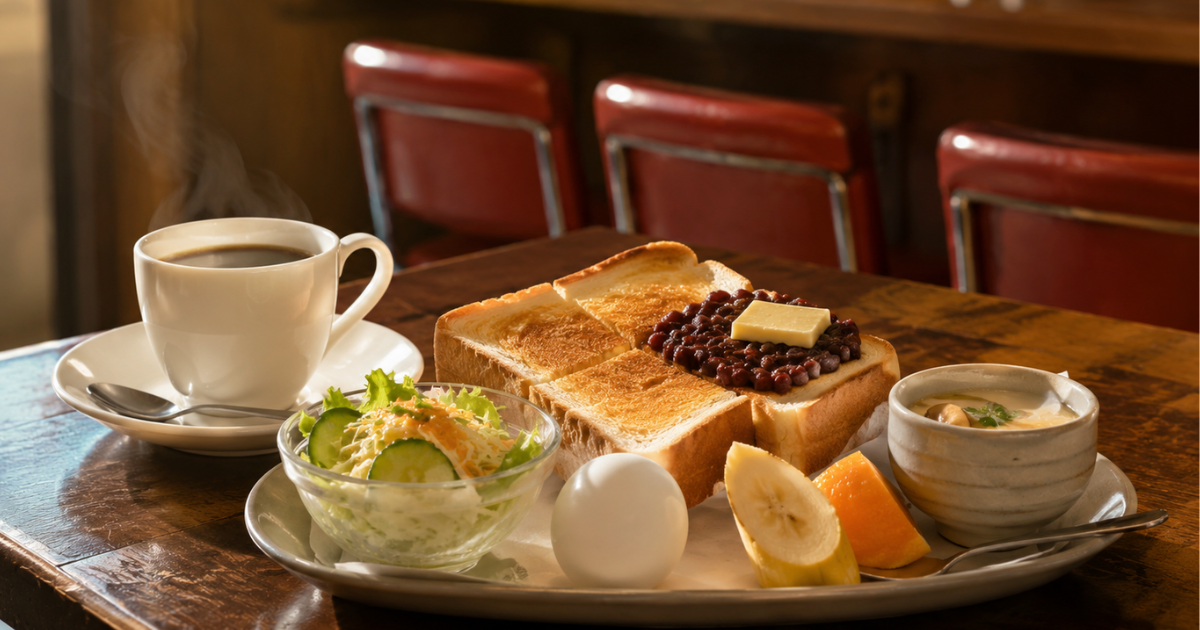
Order coffee in a Nagoya café and toast or a boiled egg may arrive with it. In some places, the tray also holds salad, fruit, or even savory steamed egg custard. What surprises a visitor is simply an ordinary morning for many local people. Why did this service grow here, and why did it become so generous? In this essay, I explore the competing origin stories, the Bishu textile trade, café competition, and the bonds between owners and regulars. A few small dishes beside one cup of coffee reveal a great deal about commerce and everyday life in Nagoya.
“Morning” Is Not Just Breakfast
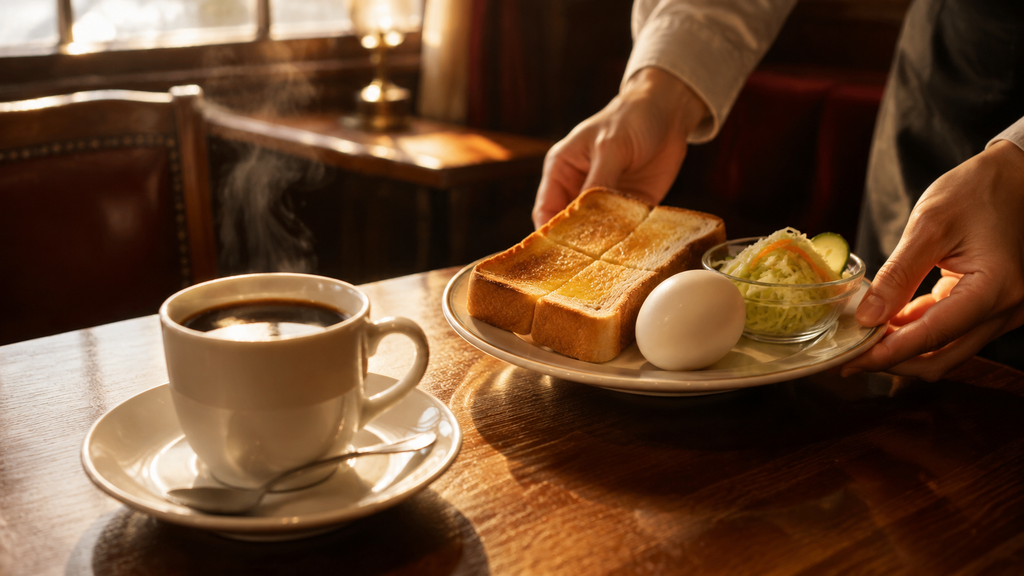
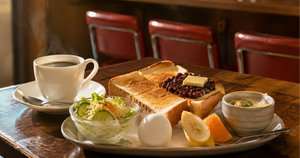
Walk into a café in Nagoya early in the day, order a single cup of coffee, and something unexpected may arrive with it: toast and a boiled egg that you never asked for. In some cafés, the plate is joined by salad, yogurt, fruit, soup, or even chawanmushi, a savory steamed egg custard. A first-time visitor might wonder whether the server has brought the wrong order. In fact, this is exactly what many local people mean by “morning.”
In English, morning is simply a time of day. In this part of Japan, however, the borrowed word has acquired a special meaning. A “morning service” is a café offer, available during certain hours, in which a drink comes with a light meal. The classic version is toast and an egg included in the price of coffee or tea. Yet not every extra is free. Some cafés provide a basic plate at no additional charge and offer more elaborate choices for a few hundred yen. Others sell a set at a fixed price, or let customers choose rice, noodles, or Japanese side dishes. Morning service is therefore not the name of one standardized dish. It is a flexible system that each café can shape in its own way.
Aichi Prefecture’s official tourism website highlights the same variety: some mornings include salad and dessert, some feature a Japanese-style dish, and others can be upgraded for an extra charge. Although visitors speak of “Nagoya morning” as if it were a single specialty, the reality is closer to a collection of thousands of local interpretations. That freedom gave cafés room to add one more item, then another, until modest hospitality could look like a small feast.
The word Nagoya also needs some explanation. This culture is not confined to the administrative boundaries of Nagoya City. It is especially strong across the wider daily travel area that runs through western Aichi, the Owari region, Ichinomiya, and southern Gifu. Toyohashi, in eastern Aichi, has its own origin story as well. “Nagoya morning” became the convenient national label, but the culture was built by café owners and customers across a much broader region.
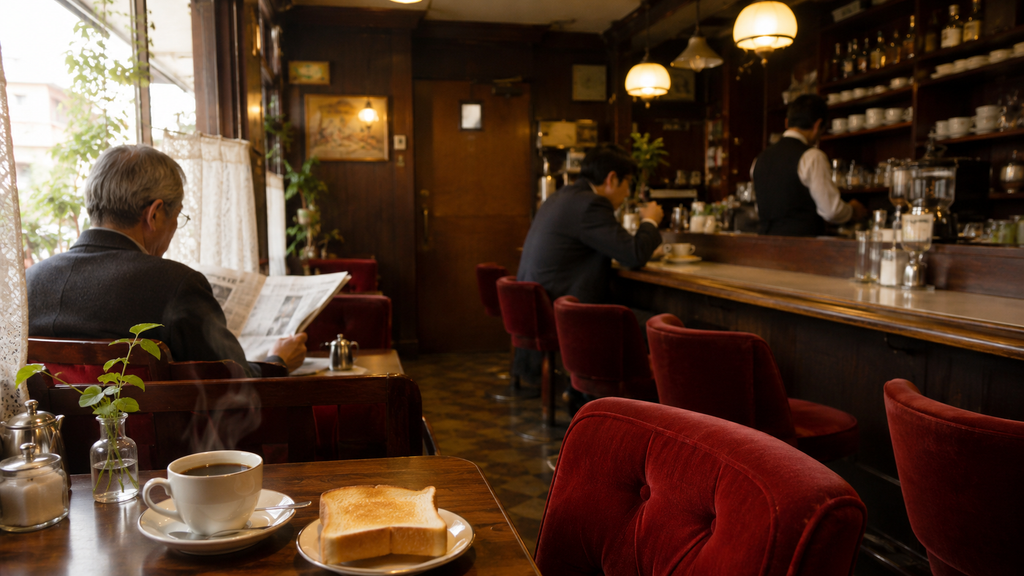
Famous cafés in the city center are only one part of the picture. Small establishments in residential districts, shopping streets, and along major roads also switch on their lights early. Drivers stop on their way to work, neighbors arrive during a morning walk, and office workers read the paper before beginning the day. Morning service spread because it fit ordinary patterns of movement. It was useful, repeatable, and close to home—not merely a regional specialty reserved for visitors or celebrations.
Where Did It Begin? The Stories of Ichinomiya and Toyohashi

Anyone looking for the first morning service will soon discover that there is no single, uncontested answer. The best-known explanation connects it with the textile industry of Bishu, the historic textile-producing region centered on Ichinomiya. Materials published by Ichinomiya City state that the area’s distinctive morning-service culture emerged around the late 1950s, when the textile business was at its height.
At that time, weaving mills, fabric and yarn dealers, machinery suppliers, and processing companies formed a tightly connected business network. The constant noise of looms could make a factory an inconvenient place for a calm conversation. Traders who began work early therefore met in nearby cafés and discussed business over coffee. According to the story passed down in the region, café owners began adding small items such as boiled eggs or peanuts as a gesture of welcome.
Toyohashi City, meanwhile, has also introduced morning service as something believed to have started in a Toyohashi café, while carefully noting that other theories exist. Elsewhere, individual cafés are remembered as the first, and different accounts describe owners offering a little food to merchants who came in early. These memories are valuable parts of local culture, but later testimony is not enough to identify one definitive first café.
Perhaps the most useful question is not which city can claim the invention. During the 1950s and 1960s, several commercial cities in Aichi had the same ingredients: people working from early morning, a need for informal meeting places, and café owners who wanted to look after their customers. Similar services may have appeared in more than one place and then spread through imitation, competition, and everyday travel.
Nagoya also had a much older culture of welcoming people with tea. The city’s official tourism materials describe how the lords of the Owari domain enjoyed the tea ceremony and how tea culture spread among townspeople. This does not prove a direct line from an Edo-period tea gathering to a twentieth-century café breakfast. It is better understood as cultural background: the region was already familiar with the idea that a drink, a small accompaniment, and conversation could form an act of hospitality.
Postwar cafés also performed a social function that went beyond serving food. They offered a neutral place—neither home nor workplace—where people could meet, exchange news, and pause. Before mobile phones and online meeting tools, a café used for business conversations could resemble a modest shared office or neighborhood lounge. A small breakfast gave people another reason to stay. Repeated mornings allowed relationships among customers, owners, and local businesses to develop gradually.
A Crowded Café Landscape Encouraged “One More Item”
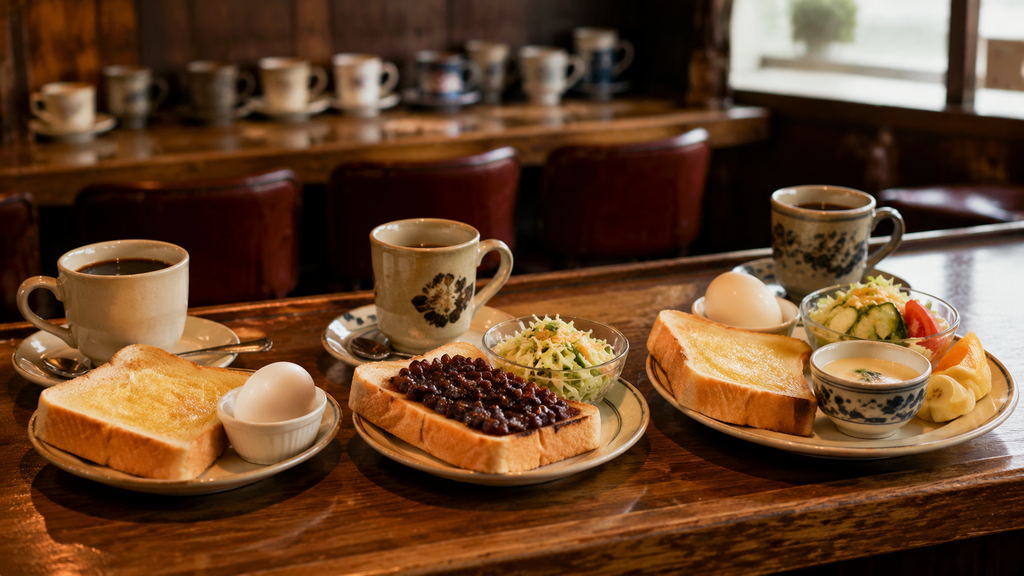
The reason morning service began is not necessarily the same as the reason it became generous. How did a small complimentary snack develop into a breakfast with salad, fruit, and dessert? Two conditions matter: the high concentration of cafés and the presence of customers who returned again and again.
According to Japan’s 2021 Economic Census, Aichi had 6,171 cafés, the second-highest total among Japan’s prefectures after Osaka. That was 0.82 cafés per 1,000 residents, compared with a national average of 0.47. An older Nagoya City dataset counted 3,111 cafés within the city in 2016. The city also reported that, on average from 2017 through 2019, households of two or more people spent 12,768 yen a year at cafés. Among the cities covered by the ranking, only Gifu spent more. The survey years and the statistical definition of a café must be kept in mind, but the pattern is clear: cafés have been unusually numerous and regularly used in this region.
A large number of cafés gives customers choices. If several cafés are within easy reach, people can compare them: one includes an egg, another adds salad, and a third serves fruit as well. Morning service becomes an immediate way for a small independent café to distinguish itself. One owner adds toast; another adds an egg; another turns the same idea into a carefully arranged plate. Statistics alone cannot prove a direct causal relationship between café density and the number of side dishes. Still, when density is considered alongside the extraordinary variety of local morning offers, competition is a convincing part of the explanation.
This was not simply a contest to place the greatest amount of food on a tray. Regulars who visit every morning notice details that a one-time tourist may miss: how the egg is cooked, how thick the toast is, how quickly the coffee arrives, and even where the newspapers are kept. An abundant plate may attract attention, but comfort and trust are what turn a café into “my usual place.”
Regular traffic can also help a café plan. If a predictable number of people arrive during the same morning hours, an owner can estimate how much bread and how many eggs to prepare. Familiar, inexpensive ingredients can be purchased consistently and served efficiently. This does not make every generous morning profitable, nor does it remove the strain on small businesses. It does suggest that abundance was often built through daily operational knowledge, not by carelessly giving away expensive food.
More Than Cheap: The Meaning of Good Value
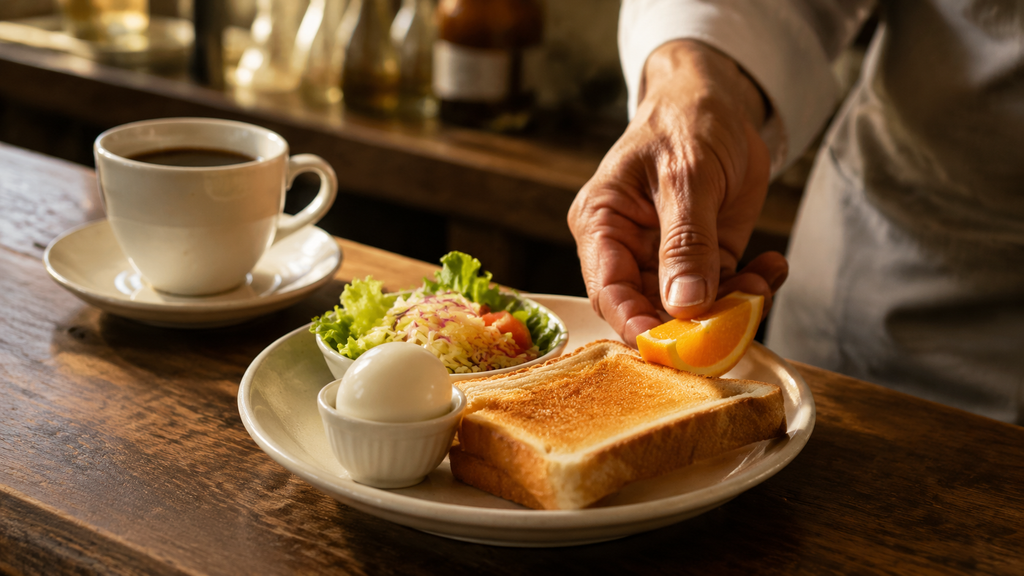
Nagoya’s morning culture is sometimes reduced to a stereotype: local people are thrifty, so they love getting food for free. That explanation is too simple. It does not tell us why café owners would spend time and money preparing extras. If customers always gained and cafés always lost, the custom would be unlikely to survive for decades.
A more useful idea is the Japanese expression oneuchi, often used in and around Nagoya. It means more than “cheap.” Something has oneuchi when the satisfaction it provides feels greater than the price paid. Toast and an egg served with one cup of coffee make a customer feel welcomed. For the café, the service helps fill seats in the morning, maintains a relationship with regulars, and may encourage people to return later in the day. A small plate can act like an advertisement, but one expressed through care rather than a slogan.
The generosity of morning service does not always depend on expensive ingredients. Half a slice of thick toast, a carefully boiled egg, a small salad, and a piece of seasonal fruit are all familiar foods. Arranged on separate plates or in little bowls, however, they create a sense of abundance. A café that serves chawanmushi, a rice ball, or udon adds the personality of its owner and a taste of the local home kitchen. Luxury here does not mean a high price. It means the pleasant surprise of receiving more attention and choice than expected.
Rising food, energy, and labor costs have made the old model harder to maintain. Some cafés now keep the complimentary plate small and offer ogura toast, salad, or other additions for an extra charge. This is not necessarily the decline of the culture. It can be a practical way to preserve it. Morning service is best understood not by asking whether every item is free, but by noticing how each café assembles a satisfying start to the day within its own limits.
Many neighborhood cafés also face aging owners and a lack of successors. At the same time, younger operators have begun taking over older spaces, preserving their atmosphere while introducing house-roasted coffee, local ingredients, or new pricing models. Tradition does not have to mean freezing one menu forever. If the essential promise remains—a comfortable morning and a sense that the customer is welcome—then changes in food, price, and style can help carry the culture forward.
A Tourist Attraction Built on an Ordinary Morning
Nagoya morning service is now a tourist attraction. The city’s official tourism website features cafés such as Coffee House KAKO Hanaguruma near Nagoya Station, BUCYO COFFEE, Coffee Matsuba near Endoji Shopping Street, and Kissaten New Poppy in the historic Shikemichi area. Visitors can find toast covered with ogura red-bean paste or kinako soybean butter, jewel-like spreads of colorful jam, and breakfasts that incorporate Japanese dishes. Many are as photogenic as they are filling.
First-time visitors should check the service hours and pricing system on the menu or at the entrance. Some places include food in the price of a drink; others charge for upgrades. Ogura toast is one of Nagoya’s best-known café foods, but it is not automatically included in every complimentary morning. Business hours, days off, prices, and menu contents change, so current information from the café should always be checked before a visit.
It is also worth looking beyond the plate. Notice the person reading a newspaper, neighbors exchanging news, or someone quietly drinking coffee before work. In some cafés, an owner knows a regular’s preference so well that “the usual” is enough to place an order. Morning service was not originally invented as a performance for visitors. It grew from an ordinary local routine.
There is no single reason Nagoya’s morning became so generous. Textile traders and early business meetings, a remarkable number of cafés, competition between neighboring shops, long relationships with regular customers, and a taste for good value all contributed. Over decades, one small dish appeared beside the coffee, followed by another.
A generous Nagoya morning is not a display of extravagance. It is accumulated ingenuity: the art of giving a customer a little more pleasure within a limited price. When a café door opens in Nagoya and toast and an egg arrive beside a cup of coffee, the tray carries more than breakfast. It carries the history of local commerce, the warmth of a neighborhood meeting place, and a quiet message from the café: Thank you for coming again today.
A traveler who wants to understand that message should resist rushing through breakfast. One morning might be spent at a well-known café with a colorful signature plate; another could be spent quietly in a long-running neighborhood shop. The two experiences may look completely different, yet both belong to the same culture. Visit more than one kind of café if time allows. The variety itself reveals the answer: Nagoya’s morning is generous not because every café follows one rule, but because generations of owners have found their own way to offer customers a little more.
Final Thoughts
Nagoya’s generous morning is more than a “free extra.” It reflects decades of small decisions: welcoming early workers, providing a place for business conversations, and giving neighbors a reason to return. If you visit Nagoya, look beyond the quantity of food. Notice the newspapers, familiar greetings, and quiet rhythm of the room. There you may find the ordinary local morning that existed long before it became a tourist attraction. What small dish beside your coffee would make you want to return tomorrow?
The Japanese version of this article is here.↓↓↓