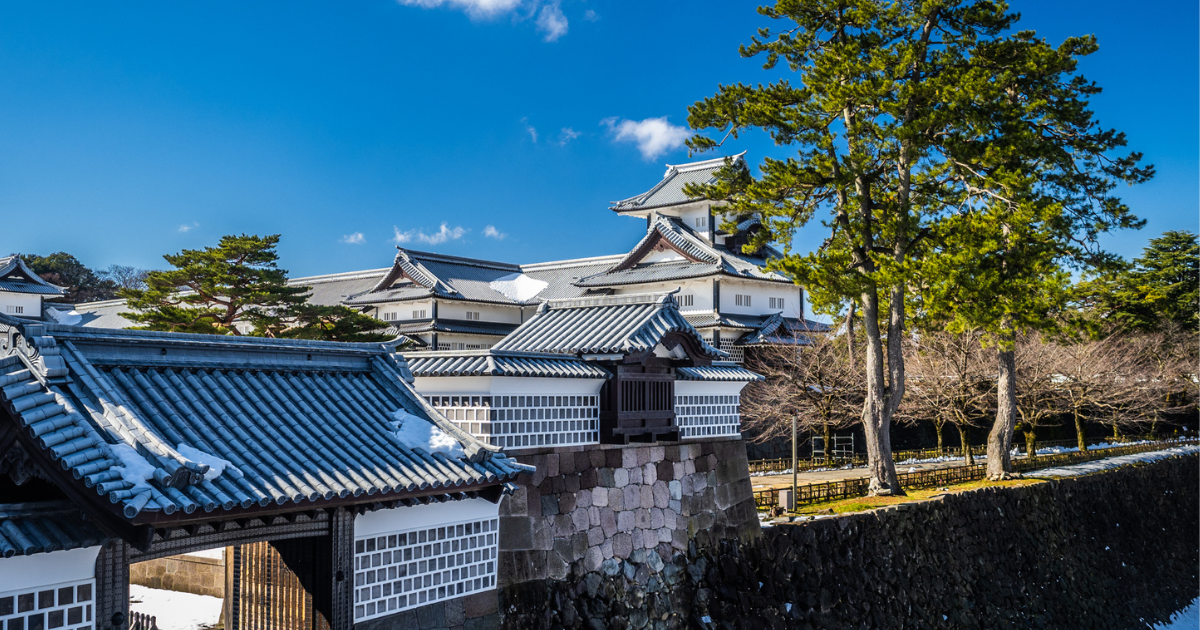
What comes to mind when you think of Kanazawa? Kenrokuen Garden, Kanazawa Castle, the samurai streets of Nagamachi, or the wooden facades of the Higashi Chaya District? Each is a celebrated sight in its own right. But while researching this essay, I began to feel that seeing them only as separate attractions misses something important about the city.
Kanazawa was built as a castle town. Samurai districts spread around the castle, merchants and craftspeople lived along important routes, temples gathered in particular areas, and canals supplied water that helped the city function. Once you start looking at Kanazawa that way, even a winding road, a narrow slope, or a quiet stream beside an earthen wall can become part of the story.
Travel often encourages us to move efficiently from one famous place to the next. Kanazawa, however, may be a city where the spaces in between deserve just as much attention.
Rather than trying to give a complete history of the Kaga domain, this essay looks at how the structure of a castle town can still be read in present-day Kanazawa. It follows the city beyond the castle itself, through samurai neighborhoods, merchant areas, temple districts, teahouse streets, waterways, and roads that have carried generations of everyday life.
If you visit Kanazawa someday, try looking up from the map once in a while and asking a simple question: Why does this street turn here?
That small question may be enough to turn an ordinary walk into a journey through history.
Introduction
Instead of seeing Kanazawa simply as a tourist destination with old streets and historic buildings, try walking through it as a city that was designed around a castle. Samurai residences, machiya townhouses, temples, teahouse districts, canals, slopes, and winding streets then begin to connect, not as separate attractions, but as parts of a single urban plan. For this essay, I looked into how the great castle town of the Kaga domain took shape and why its character can still be felt on foot today.
Kanazawa Was a Town Before It Became a Castle Town
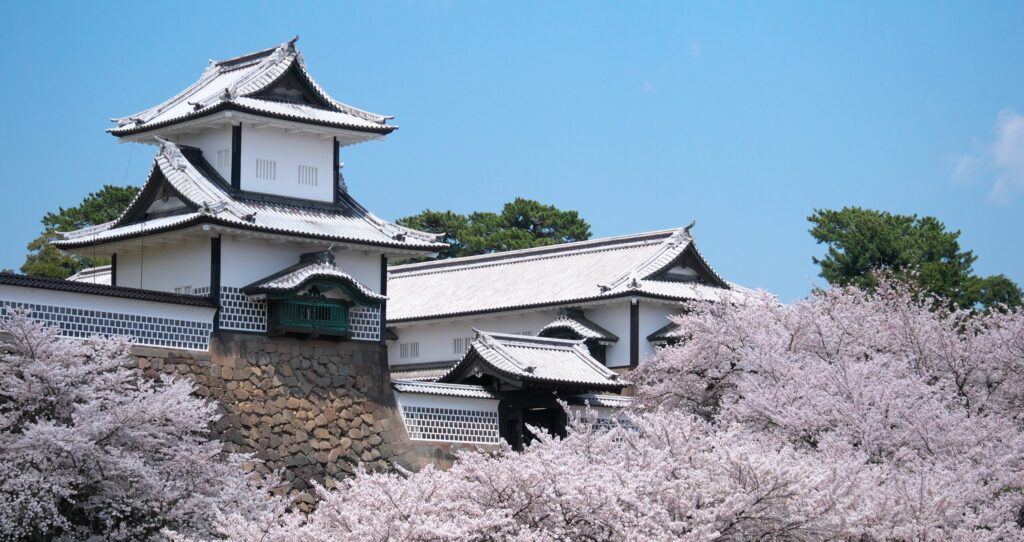
When people think of walking around Kanazawa, Kanazawa Castle and Kenrokuen Garden are often the first places that come to mind. Yet if we want to understand Kanazawa as a castle town, its story does not begin at the moment the castle was built. That was one of the first things that caught my attention when I began looking into how the city developed.
From the latter half of the 15th century, Jodo Shinshu Buddhism gained influence in what is now central Kanazawa, and a religious base known as Kanazawa Mido was eventually established there. Settlements such as Gomachi and Minamicho formed around it, and the area developed into a religious town that drew people together. In 1580, Sakuma Morimasa, fighting on the side of Oda Nobunaga, captured Kanazawa Mido and built a castle there. After the Battle of Shizugatake in 1583, Maeda Toshiie entered Kanazawa Castle. From that point, the Maeda family began the full-scale development of the castle town.
The Maeda family came to rule a vast territory spanning Kaga, Noto, and Etchu, and their domain grew into the great fief known as Kaga Hyakumangoku, or the “Million-Koku” domain. Kanazawa Castle stood at the political center of this domain, while a city of samurai, townspeople, craftspeople, temples, and shrines took shape around it. This was not simply a matter of improving the castle itself. It was large-scale urban planning that combined residential areas for retainers, merchant districts, relocated temples, outer defensive enclosures and moats, and an organized street network.
The important point is that a castle town was not simply a place where more and more houses happened to appear beside a castle. Decisions had to be made about who would live where, which routes would become major roads, where water would come from, and how the town could be defended if an enemy entered it. Politics, defense, transportation, commerce, and daily life all overlapped in determining the shape of the city itself.
Kanazawa’s terrain also had a major influence on its urban form. The city includes areas of varying elevation, such as the Teramachi and Kodatsuno plateaus and Mount Utatsu, while the Sai and Asano rivers flow between them.
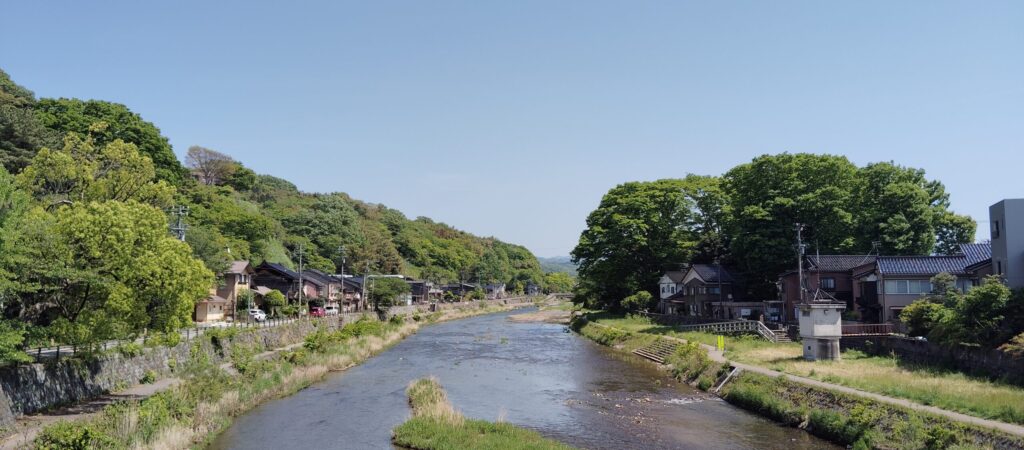
On a modern map, a road may seem as though it ought to continue straight, only to bend unexpectedly, or a narrow slope may suddenly appear. These are not merely inconveniences. They are also the result of natural topography layered together with the planning of the castle town.
Walking through Kanazawa today, then, is not only about going to see buildings from the Edo period. It is also a way of reading the ideas behind an older city through the direction of its roads, the distance from its rivers, and even the position of its slopes.
From Kanazawa Castle to Nagamachi:Walking Through the Samurai District
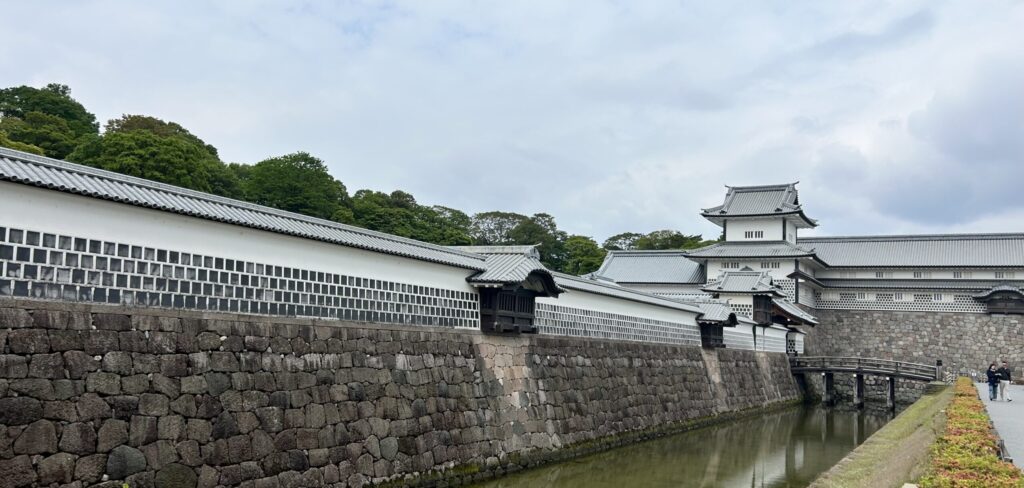
If we want to read Kanazawa as a castle town, it helps to begin with Kanazawa Castle at the center. During the feudal period, samurai residential areas are said to have occupied roughly 60 percent of the castle town. Samurai districts spread around the castle, and within them lived people of different ranks and roles, from senior retainers to middle-ranking warriors and ashigaru foot soldiers.
One of the easiest places to sense this legacy today is the Nagamachi Samurai District, southwest of Kanazawa Castle.
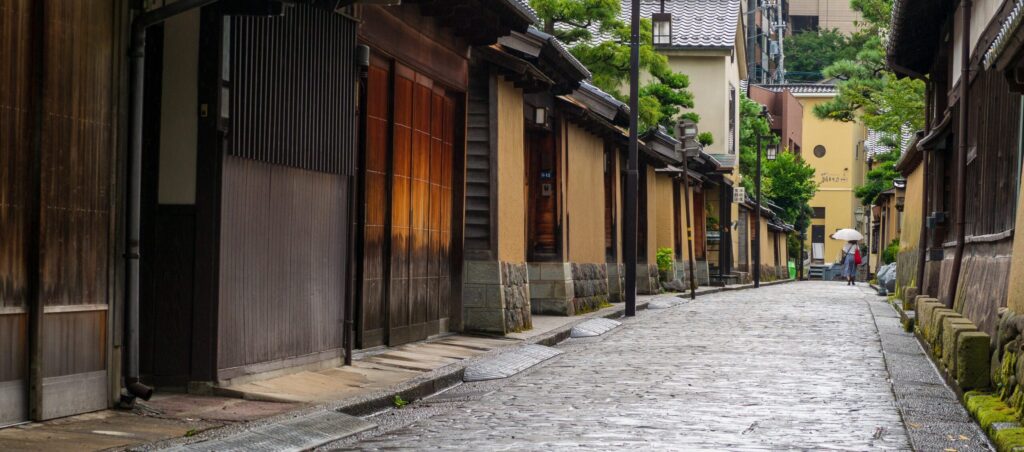
It lies only a short walk from the busy Korinbo shopping area, yet as soon as you enter its narrow lanes, earthen walls, nagayamon gates, and waterways, the atmosphere seems to change. During the feudal period, this was an area where upper- and middle-ranking samurai lived, and characteristics of a former samurai neighborhood can still be seen in the streetscape.
What deserves attention in Nagamachi is not only the interiors of impressive residences. For a series about walking, the lanes and earthen walls connecting one property to another may be even more revealing.
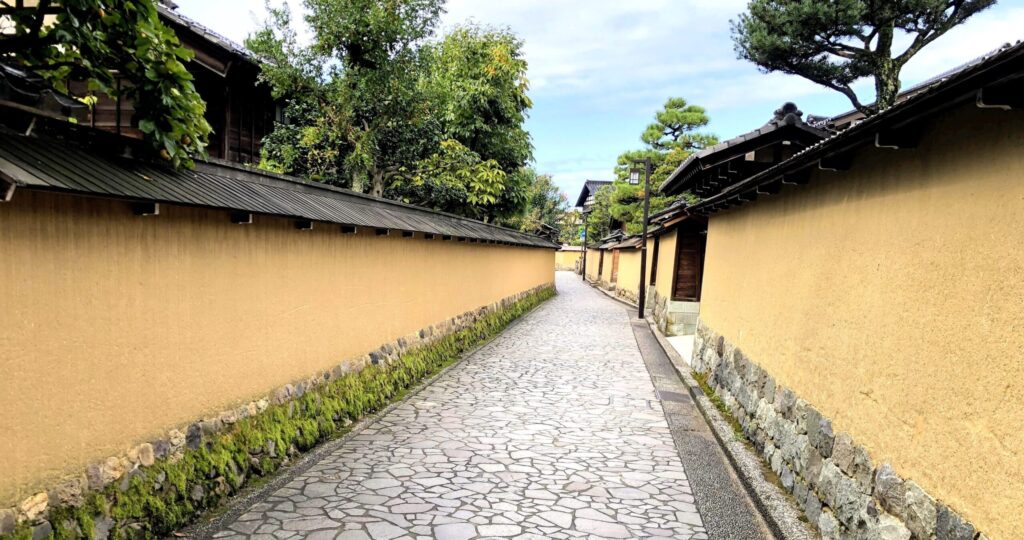
The streets are not excessively wide, nor do they always offer a long, uninterrupted view ahead. In some castle towns, bends and changes in sightlines reflected not only the natural terrain but also defensive considerations. The logic behind these streets is very different from that of a modern city designed primarily around automobiles.
Another essential part of the Nagamachi landscape is the Onosho Canal.
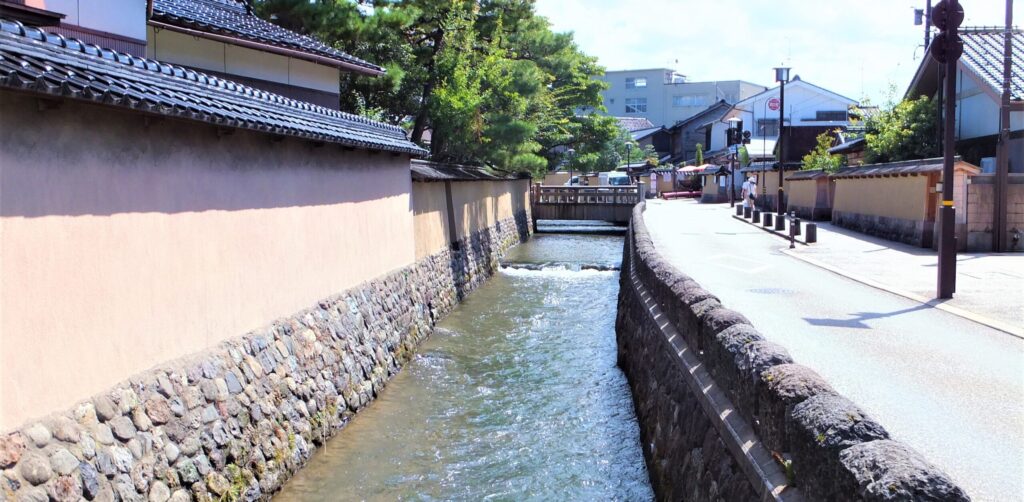
Fed by the Sai River, it is one of Kanazawa’s older waterways. During the Edo period, it served not only as a source of water for daily use and firefighting, but also in the construction of Kanazawa Castle and in transporting goods into the castle town. Today it flows quietly beside earthen walls, but it was once practical infrastructure that helped keep the city functioning.
In winter, the earthen walls of Nagamachi are protected with woven straw coverings known as komogake, which help shield them from snow and freezing temperatures. The sight is familiar from travel photographs, but its origins are practical rather than decorative. Historical scenery is beautiful not because it was originally created for visitors, but because methods developed to sustain everyday life often became part of the distinctive landscape of a place.
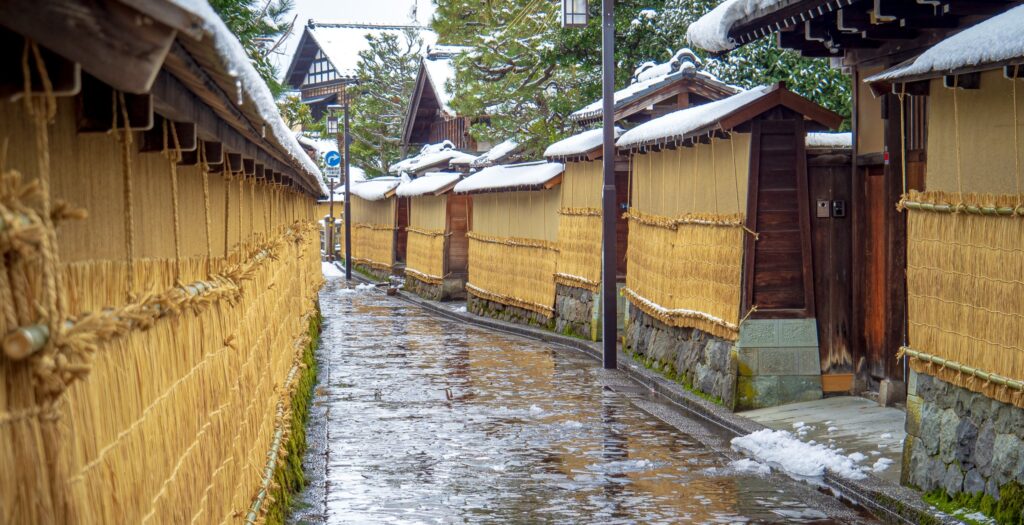
The phrase “samurai residence” can bring to mind elegant gardens and imposing architecture. But when thinking about a castle town, it is worth remembering the people who lived their ordinary lives there as well: samurai walking to the castle for duty, families maintaining households, people caring for the residences, and residents drawing on the canals for everyday needs. Behind today’s quiet lanes once stretched a continuous world of daily routines.
A castle town is not a story about a lord and his castle alone. Walking through Nagamachi makes that especially clear.
More Than Samurai — Merchant Quarters, Temple Districts, and Teahouse Streets
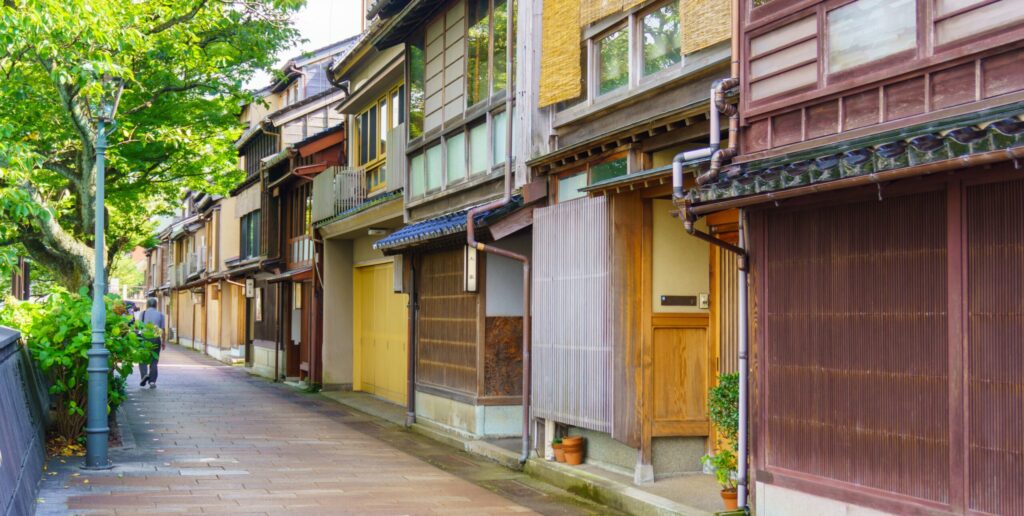
What makes Kanazawa especially interesting as a castle town is that the samurai districts alone do not reveal the whole picture. During the feudal period, residential areas for townspeople made up roughly 30 percent of the town and spread along the Hokkoku Kaido highway and other important routes. Merchants, craftspeople, and those who transported goods into the city lived there, supporting the castle and the samurai population economically.
In former merchant areas, Kanazawa machiya townhouses often have comparatively narrow frontages facing the street and plots that extend far back from the road. Even within the same city, the streetscape feels different from that of the samurai areas of Nagamachi. That is because a castle town was divided into districts according to status and occupation. Places now presented together as parts of one tourist city once had very different functions.
The placement of temples is equally interesting. In Kanazawa, temple districts developed around the foot of Mount Utatsu, Kodatsuno, and the Teramachi plateau. Temples were places of worship, but grouping them near the outer edges of a castle town could also have defensive significance. At the foot of Mount Utatsu, a town plan based around approaches leading from the old Hokkoku Kaido toward the temples still survives, and the area retains a historic landscape in which temples and traditional townhouses form a single setting.
As you walk through Kanazawa, there are places where you may find yourself wondering, “Why are there so many temples gathered here?” Once that question is considered from the perspective of the castle town, the city begins to look different. The temples were not isolated landmarks. They were positioned as part of the structure of the city as a whole.
Kanazawa is also famous for the Higashi Chaya District and Kazuemachi. Higashi Chaya was formally developed as a teahouse district on the east bank of the Asano River in 1820.
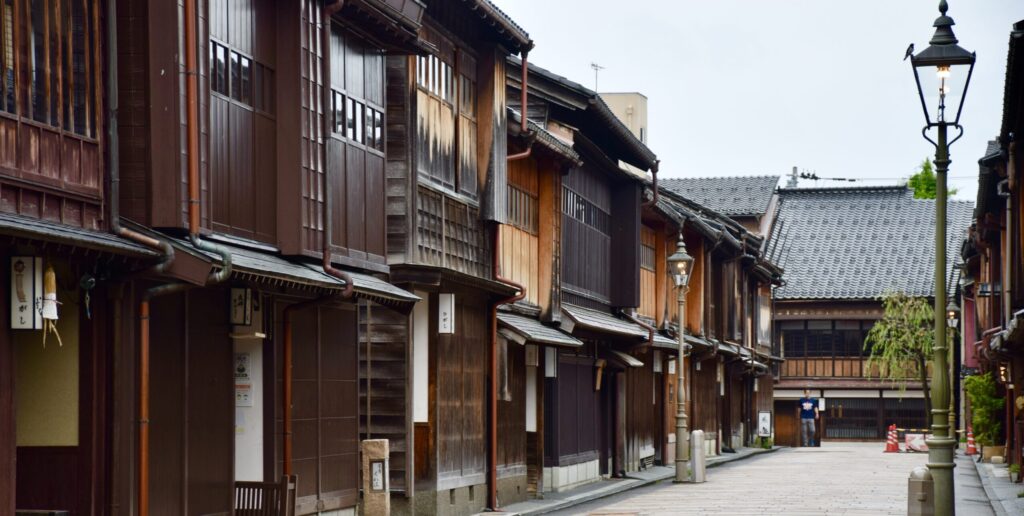
Teahouse buildings line the streets and still convey the character of the district in its earlier days. Kazuemachi, also located along the Asano River, developed from the late Edo period into the early Showa period as an area associated with teahouse culture.
One thing worth avoiding is the tendency to see every “old Kanazawa streetscape” as essentially the same. Nagamachi was a samurai district. Merchant districts grew along important roads. Temple groups occupied the foothills and plateaus. Teahouse streets developed near the Asano River. Each area came into being for different reasons, was inhabited by different people, and developed a different architectural character.
Once you walk through the city with those differences in mind, Kanazawa stops looking like a single beautiful tourism poster. Instead, it becomes a three-dimensional city made from several distinct urban worlds fitted together. That, I think, is one of the real pleasures of exploring a castle town on foot.
Waterways and Winding Streets — The Castle Town's Blueprint Still Visible Today
When old streetscapes in Kanazawa are introduced, attention naturally tends to go to the buildings. Yet one of the things I found most interesting while researching this essay was something less obvious: the underlying framework of the city beneath them.
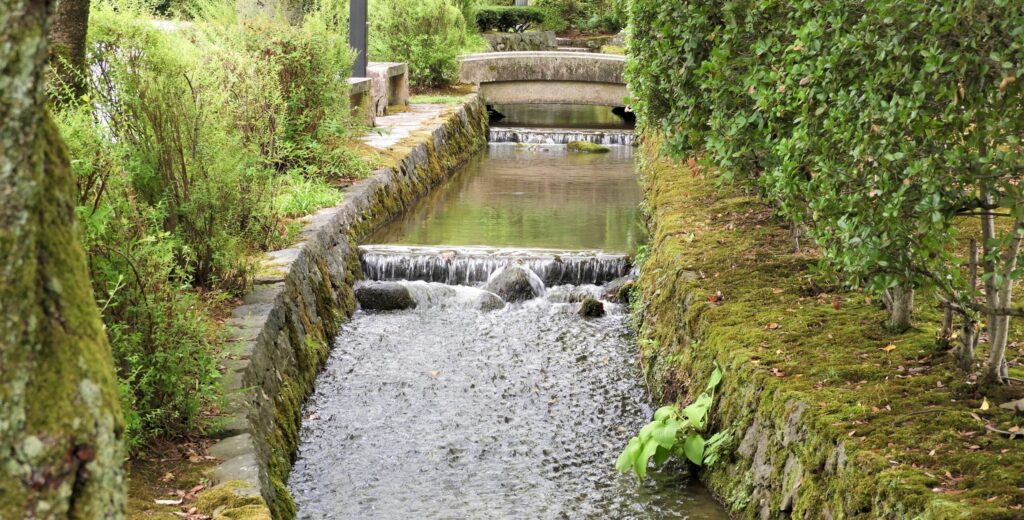
According to Kanazawa City’s plan for the preservation and improvement of historic character, the basic form of the street network that made up the castle town remains in place today. The canals flowing mainly through the former castle-town area form 55 water systems with a total length of about 150 kilometers. The fact that so many waterways still exist within a modern urban area is an important clue to understanding Kanazawa.
These canals were not created for scenery. Depending on the period and location, they served many purposes: drinking and household water, agriculture, firefighting, the transport of goods, and even the defense of the castle. The Tatsumi, Onosho, and Kuratsuki canals are among the waterways you can still encounter while walking through the city. Their flow may now seem calm and picturesque, but they were originally part of the machinery that allowed the city to function.
The same is true of the roads. Modern cities often straighten and widen streets in the interest of efficient movement. In a castle town, however, a long, straight road with a clear view into the distance was not always desirable. Defense, topography, residential divisions based on social status, and the position of temples, shrines, and waterways all shaped streets that bent, branched, and climbed or descended slopes.
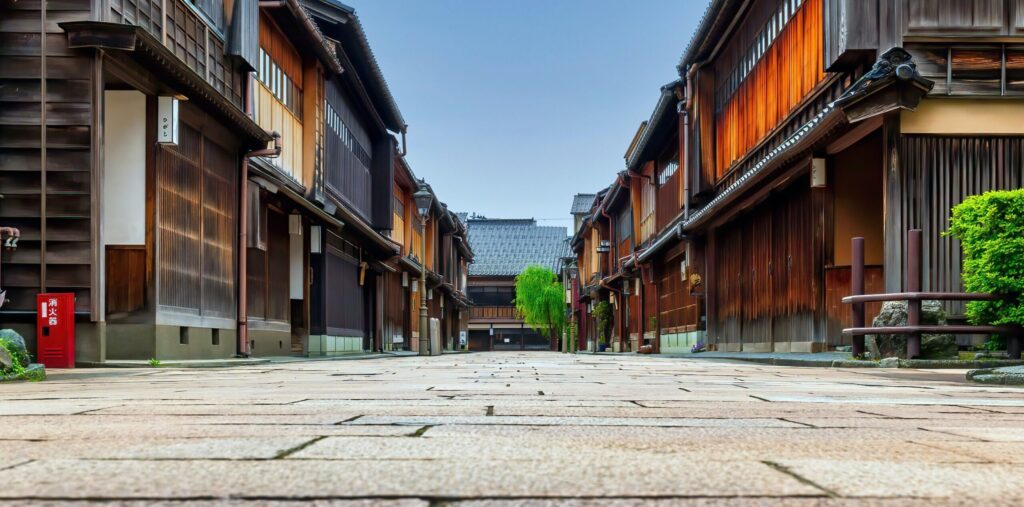
Kanazawa also retains spaces known as hiromi, where a street suddenly widens. A narrow road may open unexpectedly into a broader space, or an intersection may have an irregular shape. To modern eyes, the reason may not be immediately obvious. Compare such places with old maps of the castle town, however, and you begin to notice how the history of the city remains embedded in its present-day roads.
Unlike a historic building, these features cannot easily be fenced off and labeled, “This is the heritage site.” Roads are still used by cars and pedestrians. Canals still flow through the city. Slopes and bridges remain part of ordinary daily life.
That is exactly why the spaces between famous landmarks matter when walking through a castle town. If we hurry from one destination to the next, old routes and waterways become little more than background scenery. But slow down and ask, “Why does this street turn here?” or “Where does this canal come from, and where is it going?” and the city itself becomes a historical document.
In Kanazawa, history is not preserved only inside museums. The blueprint of the castle town can still be seen faintly through the roads and waterways people use every day. To me, that is one of the most fascinating things about walking through this city.
Why Can We Still Walk Through Edo-Period Kanazawa Today?
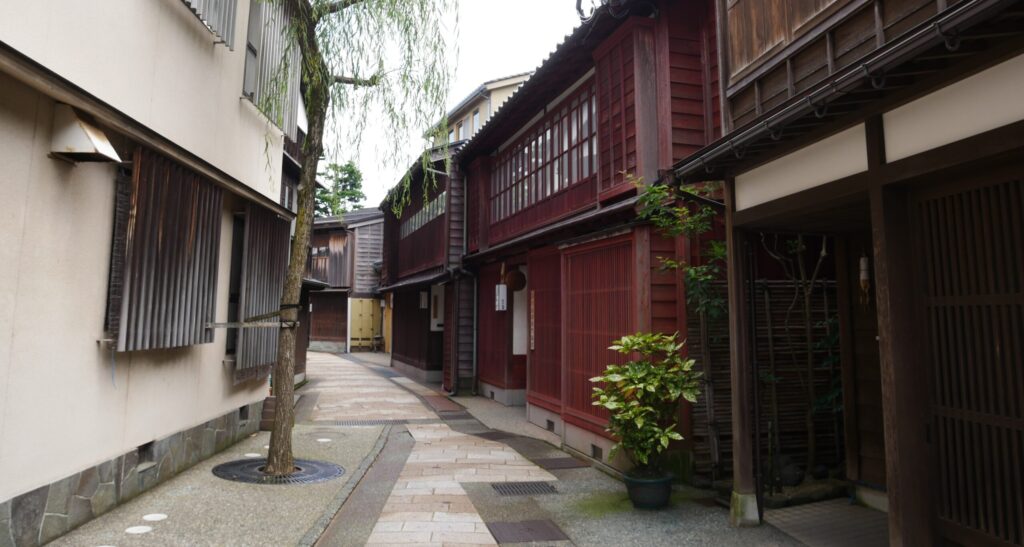
So why has Kanazawa retained so much of the character of a castle town?
Part of the answer lies in historical good fortune. Kanazawa was spared large-scale air raids during World War II and escaped the wartime destruction that devastated many urban centers. It also suffered comparatively little complete loss of its historic urban core through major natural disasters, creating conditions in which buildings and urban structures from the Edo, Meiji, Taisho, and Showa periods could remain layered together.
But that alone does not explain the Kanazawa we see today.
During Japan’s postwar period of rapid economic growth, roads were widened and new buildings appeared in cities across the country, dramatically changing many older streetscapes. Kanazawa faced the same pressures. In fact, being spared wartime destruction also meant that the city entered the era of modernization with a large stock of older buildings. It therefore had to confront a difficult question: should the old environment be preserved, or should the city be remade for a new age?
One turning point came with the “Kanazawa Diagnosis” carried out in 1967. Architect Taniguchi Yoshiro and others walked through the city and emphasized the value of Kanazawa’s historic environment, while arguing for the need to balance preservation with development. The following year, in 1968, Kanazawa City became one of the earliest local governments in Japan to establish an ordinance for the preservation of its traditional environment. Its policies continued to develop over time, expanding beyond historic streetscapes to include canals, alleyways, green spaces, temple and shrine scenery, machiya townhouses, and traditional craft skills.
What matters about present-day Kanazawa is that the city has not simply “frozen the old town in time.” The area around Kanazawa Station contains contemporary architecture; commercial districts are filled with modern shops; and new museums and cultural facilities have been created. At the same time, efforts to protect the historic environment have continued in places such as Nagamachi, the teahouse districts, temple areas, and old highways.
In other words, Kanazawa did not attempt to turn the entire city back into the Edo period. Instead, it has continued to consider what should be preserved and where new urban functions should be accepted. Since the 1968 ordinance, the city has gradually built up an approach that does not treat “preservation” and “development” as a simple either-or choice.
In 2010, the area known as “Kanazawa’s Cultural Landscape: Traditions and Culture of the Castle Town” was selected as an Important Cultural Landscape of Japan. The name itself is revealing. What is valued is not a single building or one historic street, but the landscape created through the relationship between the history of the castle town and the lives and culture of the people who inhabited it.
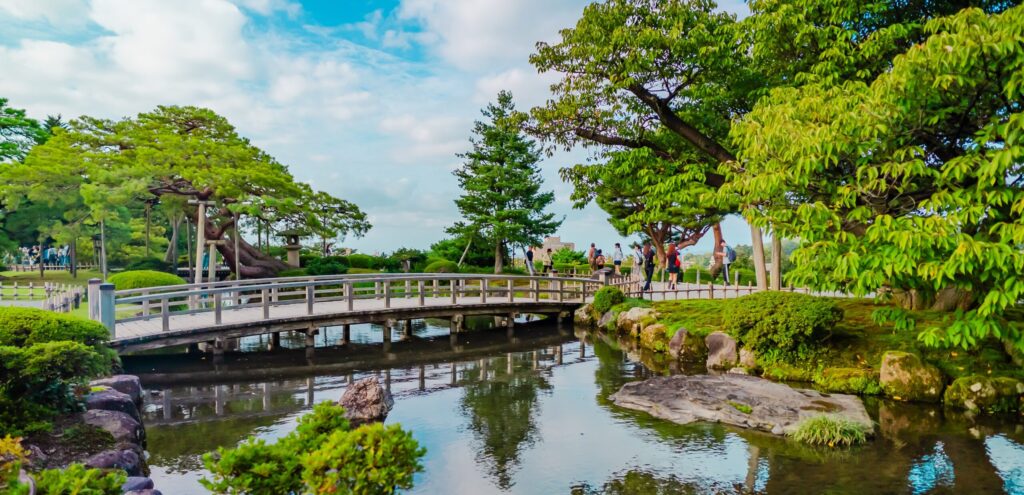
Visitors to Kanazawa can move from one famous sight to another: Kanazawa Castle, Kenrokuen Garden, Nagamachi, Higashi Chaya, and Omicho Market. But once we begin to look at the city as a castle town, these places stop feeling like separate tourist attractions. The castle stood at the center; samurai districts spread around it; merchants had their own quarters; temples gathered in other parts of the city; and waterways and roads connected those different worlds. Beneath today’s sightseeing map, the workings of a single historical city begin to appear.
Kanazawa’s appeal, then, is probably not just that many old buildings remain. It is that an urban framework created centuries ago has continued to be used within modern life, even as its form has changed. And alongside that continuity are generations of people who chose not simply to consume what happened to survive, but to pass it on to the future. Together, those two things have created the character of Kanazawa we experience today.
If your journey is only about seeing a castle, it may end when you walk out through the castle gate. But if your journey is about understanding a castle town, that is where it really begins.
Turn your back on Kanazawa Castle and walk toward Nagamachi. Follow the waterways. Look at the machiya along old roads, climb the slopes of Teramachi, cross the Asano River, and continue into the teahouse districts. Along the way, stop to ask, “Why is this place shaped like this?”
Walk in that way, and Kanazawa no longer seems merely like “a city where old Japan survives.” It begins to look like a city that is still living within more than 400 years of accumulated urban time.
Those are exactly the kinds of castle towns I hope to visit in this series.
From a journey that stops at the castle to a journey that walks through the town the castle created.
Kanazawa, the first stop in this series, may be one of the best places to discover how rewarding that kind of journey can be.
Final Thoughts
One idea stayed with me after researching Kanazawa: a historic city is not simply a place where old things happened to survive.
Kanazawa was fortunate to escape the large-scale wartime destruction that transformed many Japanese cities. Yet survival alone does not explain what we can walk through today. Streetscapes, canals, old districts, and traditional buildings also remain because generations of people made decisions about what should be protected, what could change, and how an old city could continue to function as a modern one.
That is why I have come to think of Kanazawa not as a city where “the old Japan” has been frozen in time, but as a place where an older urban framework continues to live inside the present.
Of course, famous landmarks are part of the pleasure of travel. But a castle town offers another kind of discovery. History may be waiting in the road after you leave the castle gate, in water running beneath a bridge, in the position of a temple district, or in a lane that bends for a reason you cannot immediately see. These details rarely announce themselves as attractions, yet they can tell us how a city once worked.
Kanazawa is the first stop in this series, Historical Walks: Castle Towns Worth Exploring. From here, I would like to keep looking beyond the castles themselves and into the towns they created.
From a journey that ends at the castle to one that begins there.
I am already curious to see what kind of hidden urban blueprint the next castle town will reveal.
The Japanese version of this article is here.↓↓↓