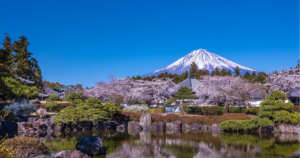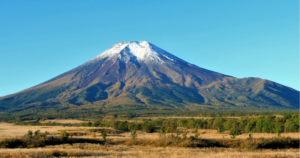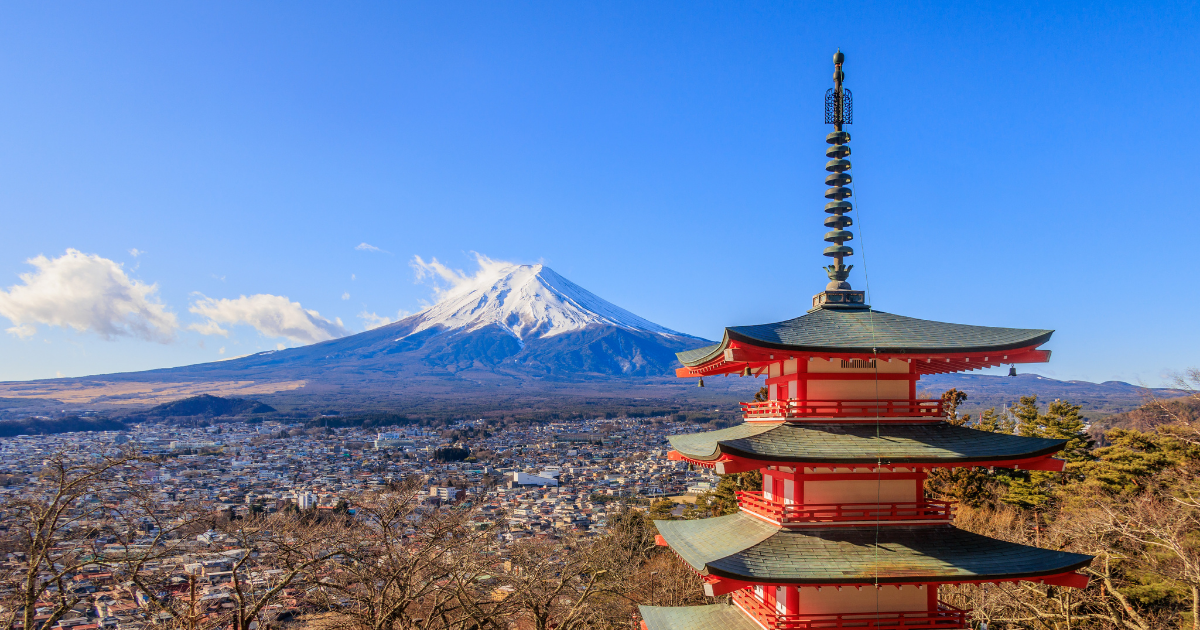
When Mount Fuji comes into view, we somehow feel the urge to point it out to someone. Whether through a window of the Shinkansen, from a hill above town, or between breaks in the clouds, catching sight of its white summit seems to brighten our mood just a little.
Is it because it is Japan’s highest mountain, or because its shape is so beautiful? Those are certainly part of the answer. Yet while researching this essay, I realised that the mountain’s special place in Japanese life rests on far more than its appearance. There are prayers born from fear of eruptions; pilgrimages once undertaken at great personal risk; the spread of Fuji-kō pilgrimage associations among ordinary people; and a shared image shaped by poetry and ukiyo-e.
Across the centuries, people have projected their own hopes, longings, and aspirations onto Mount Fuji. This essay traces the journey by which it came to hold such a special place in the Japanese heart. I hope it helps you see this familiar mountain from a slightly different perspective.
How a Distant Mountain Entered the Japanese Imagination
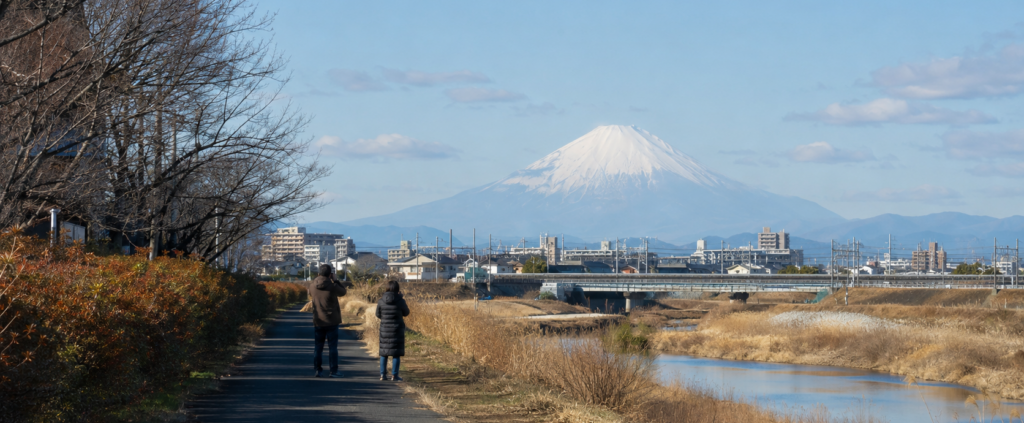
Many people in Japan know the small thrill of suddenly seeing Mount Fuji from a train window. The mountain is supposed to be there, yet when the clouds part and the summit appears, it feels like a piece of good luck. The same thing happens far from the familiar viewpoints. If its white peak can be seen from a hill in Tokyo, a stretch of coast, or a distant ridge, someone will almost certainly point and say, “That is Mount Fuji.” We may look at other mountains without knowing their names, but Mount Fuji makes us want to identify it and share the discovery.
At 3,776 metres, it is Japan’s highest mountain. Its broad base, solitary position, and graceful cone make it immediately recognisable. These features certainly help explain its special status, but height and beauty alone are not enough to turn a mountain into a national symbol. Japan has many mountains known for their difficult terrain, sacred traditions, or importance to local life. Mount Fuji, however, has come to represent something larger than one region. Across centuries, people throughout the country have treated it as a shared point of reference.
Looking into its history reveals layers of memory gathered around its outline: fear of an active volcano; prayers offered from its lower slopes; the hopes of pilgrims who risked the climb; longing expressed in poetry and tales; an ideal image circulated through woodblock prints; and the affection with which people still find it in an everyday view. Mount Fuji has never carried only one meaning. It is more like a vast vessel into which successive generations have placed their own fears, beliefs, hopes, and ideas of beauty.
From Fear of Fire to an Attitude of Reverence
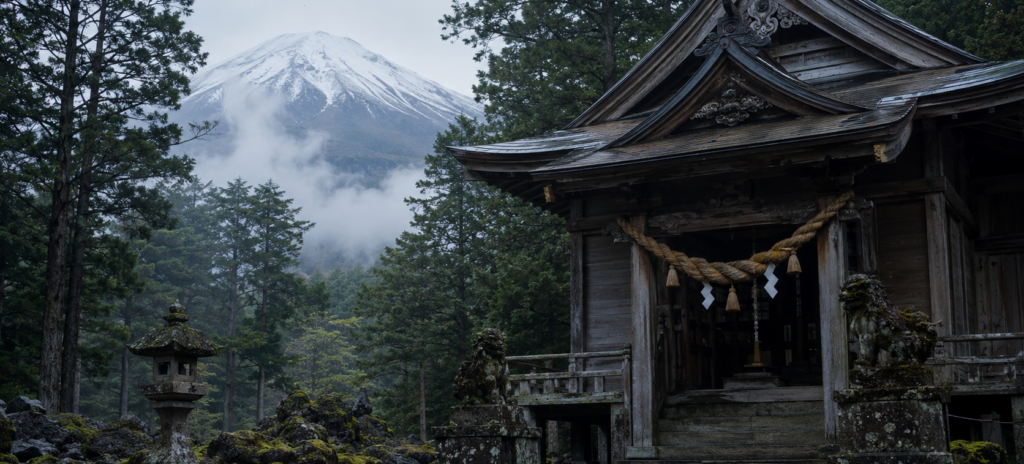
Today Mount Fuji often appears calm and perfectly composed, but its beautiful cone was built by volcanic activity. Old records describe eruptions and smoke, reminders that people living around the mountain faced a force capable of changing the land without warning. Before Fuji could be enjoyed simply as scenery, it was encountered as something beyond human control. The earliest roots of worship were grounded less in familiarity than in awe.
When eruptions were frequent, people did not necessarily approach the summit. They looked up from the foothills and worshipped from a distance, a practice known as yohai. Sengen shrines developed around the mountain as places where people prayed to the deity Asama no Okami for protection from fire and disaster. Kawaguchi Asama Shrine, for example, traces its origin to the enshrinement of the deity in 865, the year after the great Jogan eruption. Such shrines stood at a boundary between the human community and the mountain’s unpredictable power.
What matters is that awe did not remain mere terror. Ash and lava could destroy, yet over longer periods volcanic landforms and water flowing through the mountain also sustained communities. Fuji’s groundwater fed springs, fields, and settlements. Rather than imagining that nature could be fully subdued, people learned to recognise a presence that brought both danger and blessing. Prayer offered a way to acknowledge human limits and to seek a workable relationship with the land.
From a distance, Fuji seems balanced and still. Within it lies fire, and in the past that fire repeatedly broke through the surface. Serenity and power, beauty and danger, exist in the same mountain. This doubleness helped transform Fuji from a celebrated landscape into a sacred presence. When people face something they cannot entirely understand, they often give it stories, rituals, and forms of prayer. Through that process, Mount Fuji entered the deepest layers of Japanese culture.
When Climbing Was an Act of Prayer
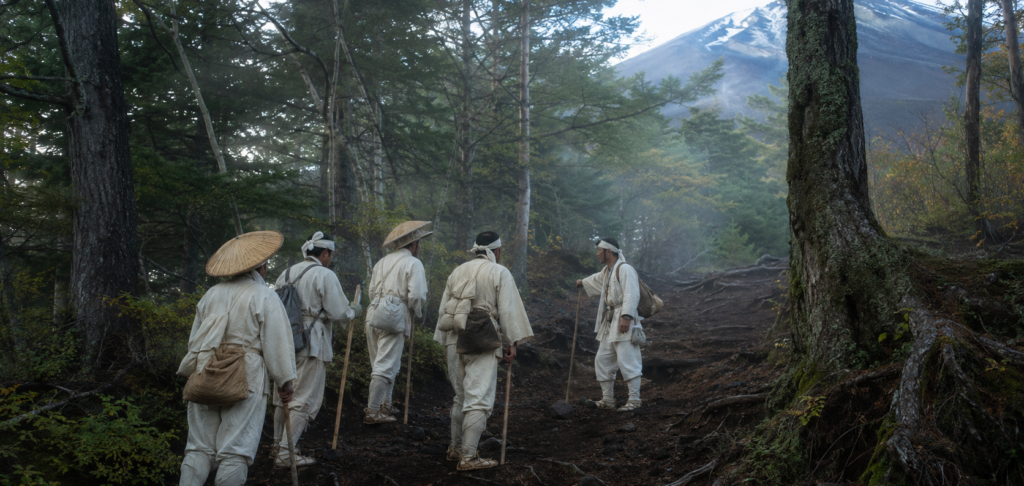
As volcanic activity became less frequent, people’s relationship with the mountain changed. Religious practitioners began to enter it rather than worship only from below, seeking proximity to the powers believed to dwell there. From the Heian period into the medieval era, Mount Fuji became a centre of mountain asceticism. In the twelfth century, the practitioner Matsudai is said to have climbed it repeatedly and helped establish a tradition of Fuji shugendo. Enduring steep slopes, cold, and wind was not simply a test of fitness. It was a religious passage away from ordinary life and back again.
For a modern climber, reaching the summit may appear to be the central achievement. In a sacred ascent, however, the entire route mattered. Pilgrims prayed at shrines near the base, purified themselves in water, passed through forest, and emerged onto the scorched, nearly plantless volcanic zone above. Each change in the landscape marked a movement away from everyday space and towards the sacred. Walking around the summit crater, a practice known as ohachi-meguri, was also a discipline rather than sightseeing. The ascent and descent could be understood symbolically as death and rebirth.
Over time, the climb ceased to belong only to specialised ascetics. From the fourteenth century, lay believers known as dosha made worship-ascents in the hope of salvation and other blessings. In the early modern era, organised confraternities called Fuji-ko spread widely, especially in Edo and its surrounding districts. Members pooled money, sent representatives, and sometimes travelled together. Through these associations, a distant sacred mountain entered the lives of merchants, artisans, and ordinary townspeople.
Miniature versions of Mount Fuji, known as Fujizuka, were built in communities around Edo. Those unable to make the difficult and expensive journey could climb a local mound and pray for the same spiritual benefit. These small mountains show that belief did not move in only one direction, from people towards the real summit. Fuji was also recreated in neighbourhoods and brought closer to daily life.
Pilgrims on the actual mountain depended on oshi, religious guides and hosts who provided prayer, lodging, meals, and practical preparation. In Fujiyoshida, many oshi houses once lined the town. They were not merely inns. They were places where travellers learned the customs of worship, prepared themselves, met companions, and began the sacred journey. Seen only from the summit, Fuji worship may look like an individual act. In practice, it rested on a network of confraternity members, leaders, guides, hosts, mountain huts, and foothill communities.
Knowing this history changes the sound of the phrase “climbing Mount Fuji.” Earlier pilgrims were not walking only towards Japan’s highest geographical point. They were confirming a wish, leaving ordinary life, carrying the hopes of others, and returning to their community changed by the journey. Mount Fuji became a mountain of the heart not only through the longing of those who viewed it from afar, but through the accumulated experience of people who walked its paths in prayer.
Poetry and Prints Carried Fuji Across Japan and Beyond
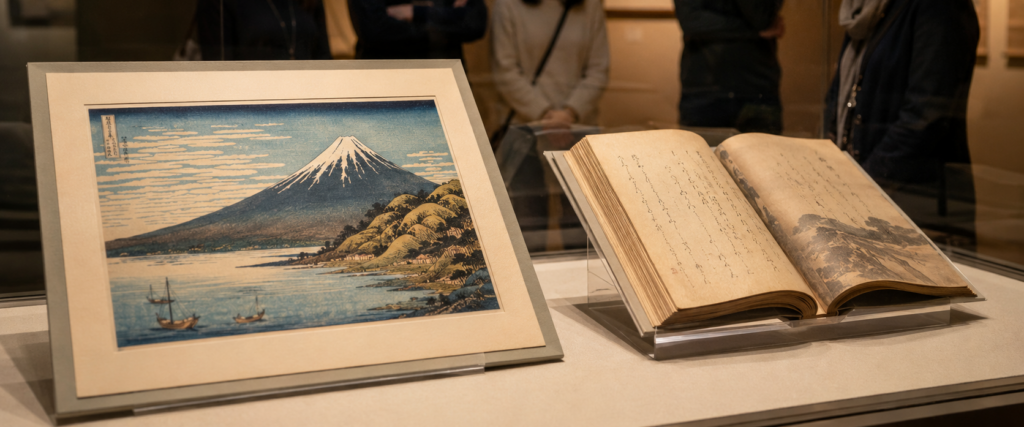
Mount Fuji did not belong only to those who climbed it. For most people, it was a mountain seen from a distance, imagined through words, or encountered in pictures made by someone else. Poems about Fuji appear in the Man’yoshu, Japan’s earliest surviving collection of poetry. The poet Yamabe no Akahito described it on a scale that seems to reach beyond the sky. In The Tale of the Bamboo Cutter, the emperor orders the elixir of immortality left by Princess Kaguya to be burned on the mountain, creating one of the legends associated with Fuji’s name. The importance of the story is not whether it records history, but that the mountain was already imagined as a threshold between the human world and another realm.
Literary Fuji was never merely a topographical report. Snow, smoke, height, and distance became a language for human feeling: longing for an absent person, love that would not disappear, desire for an unreachable world, or the wish for eternity. Because Mount Fuji could be seen from far away yet remained difficult to approach, it could receive many emotions at once. A physical mountain gradually became a shared metaphor.
Woodblock prints gave that shared image an extraordinary new reach during the Edo period. In Hokusai’s Thirty-Six Views of Mount Fuji, the mountain is not always the largest object or the obvious centre of the scene. It may appear small beyond a towering wave, sit behind people at work, or echo the shape of a building or barrel. By placing an apparently permanent mountain within the movement of ordinary life, Hokusai made Fuji monumental and familiar at the same time. Utagawa Hiroshige likewise set it within roads, coastal views, post towns, weather, and changing seasons.
Unlike a painting made for a court, temple, or wealthy patron, a woodblock print could be produced in quantity and purchased by townspeople. Viewers encountered Fuji from places they had never visited. The real experience of seeing the mountain became intertwined with the learned experience of seeing its image. Over time, society developed a shared visual idea of what “Fuji-like” beauty looked like. When we now see a blue sky, a snowy cap, and a long symmetrical ridge and immediately think of Japan, we are drawing on a visual memory constructed over generations.
When ukiyo-e travelled overseas in the nineteenth century, Mount Fuji travelled with it. The bold compositions, flattened colour, and unusual relationships between human figures and landscape in prints by Hokusai and Hiroshige stimulated Western artists and contributed to the wider phenomenon known as Japonisme. Fuji became not only one Japanese mountain, but also an international sign through which people imagined Japan.
That history helps explain the formal name under which Mount Fuji was inscribed on UNESCO’s World Heritage List in 2013: “Fujisan, sacred place and source of artistic inspiration.” The inscription is cultural, not simply a celebration of exceptional height or geology. It recognises a network of twenty-five component sites, including the upper mountain, pilgrimage routes, shrines, oshi lodging houses, lakes, springs, waterfalls, lava formations, and the pine grove of Miho no Matsubara. What the world recognised was the long cultural relationship through which people revered, climbed, depicted, and narrated the mountain.
A Mountain Measured by More Than Height
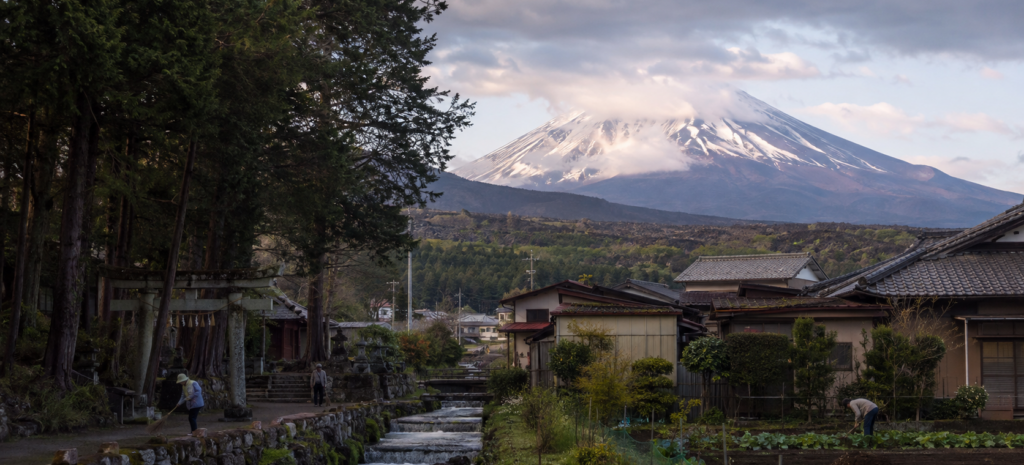
When I began researching why Mount Fuji is so special, the simplest answer seemed obvious: it is Japan’s highest and most beautiful mountain. That answer is not wrong, but it is incomplete. Fuji’s value does not reside within the mountain alone. It also lives in the relationships formed around it: the people who watched its eruptions, looked up in prayer, made the ascent, opened their homes to pilgrims, composed poems, carved printing blocks, or searched for its outline during a journey. Those accumulated connections turned a mountain into a cultural presence.
Fuji’s shape changes depending on where it is viewed. The ridgelines seen from Yamanashi and Shizuoka are not identical, and weather and season continually alter its expression. On some days it remains hidden behind cloud. Even then, people know it is there. This sense of an unseen but continuing presence resembles Fuji’s place in culture. We may not know the details of old religious practices, yet earlier hopes remain within Sengen shrines, Fujizuka mounds, paintings, poems, place names, festivals, and familiar designs.
The more we love Fuji as a symbol, the easier it is to confine it to one perfect photograph. The real mountain is not a flawless diagram. It is an active volcano exposed to wind and rain, holding forests, lava formations, and the water systems on which foothill communities depend. Its religious traditions also changed over time and included many different participants and interpretations. To care for Mount Fuji, therefore, cannot mean protecting only a beautiful summit view. It means preserving the connections among pilgrimage routes, shrines, oshi houses, lakes, springs, waterfalls, the distant pine shore, and the stories that make these places part of one cultural landscape.
Mount Fuji became a mountain of the Japanese heart not because every Japanese person holds the same belief or emotion. For one person it is sacred; for another, the landscape of home; for another, an artistic subject or a goal to climb once in a lifetime. Fuji has been able to contain these different responses without reducing them to one meaning. Perhaps that openness is why each age can place something new upon its old outline.
The next time Mount Fuji appears, someone will probably say, “There it is.” Behind that brief remark lies more than a thousand years of awe, prayer, travel, storytelling, and art. One distant mountain has joined the memories of people who never met and did not always believe the same things. That, more than its height alone, is why Mount Fuji continues to hold such a special place in the Japanese heart.
Final Thoughts
As I followed Mount Fuji’s history, what stayed with me most was the realisation that calling it ‘a mountain of the Japanese heart’ does not mean that everyone shares the same feelings about it.
Some look up to it as a sacred mountain. Some know it as part of the landscape of home. Some are drawn to Fuji in art, while others dream of standing on its summit at least once.
Mount Fuji has not forced these different feelings into a single mould. Instead, it has stood for centuries, quietly making room for them all.
What deserves protection as a World Cultural Heritage property is more than its beautifully balanced outline. It is the connection between the climbing routes, shrines, lakes and springs, towns at the foot of the mountain, and memories passed down from one generation to the next.
The next time you catch sight of Mount Fuji, I hope you will pause for a moment to think of the countless stories layered behind it. Why can a mountain in the distance feel so close to us? Perhaps part of the answer lies within each of us.
The Japanese version of this article is here.↓↓↓